Fish · Java Loach
Java Loach — Pangio oblonga: Habitat and Care
A plain cinnamon-brown social loach for a shaded, sandy aquarium floor. Give the group intentional food, secure equipment and several accessible refuges; the dark body does not make it a banded kuhli with the colour removed.
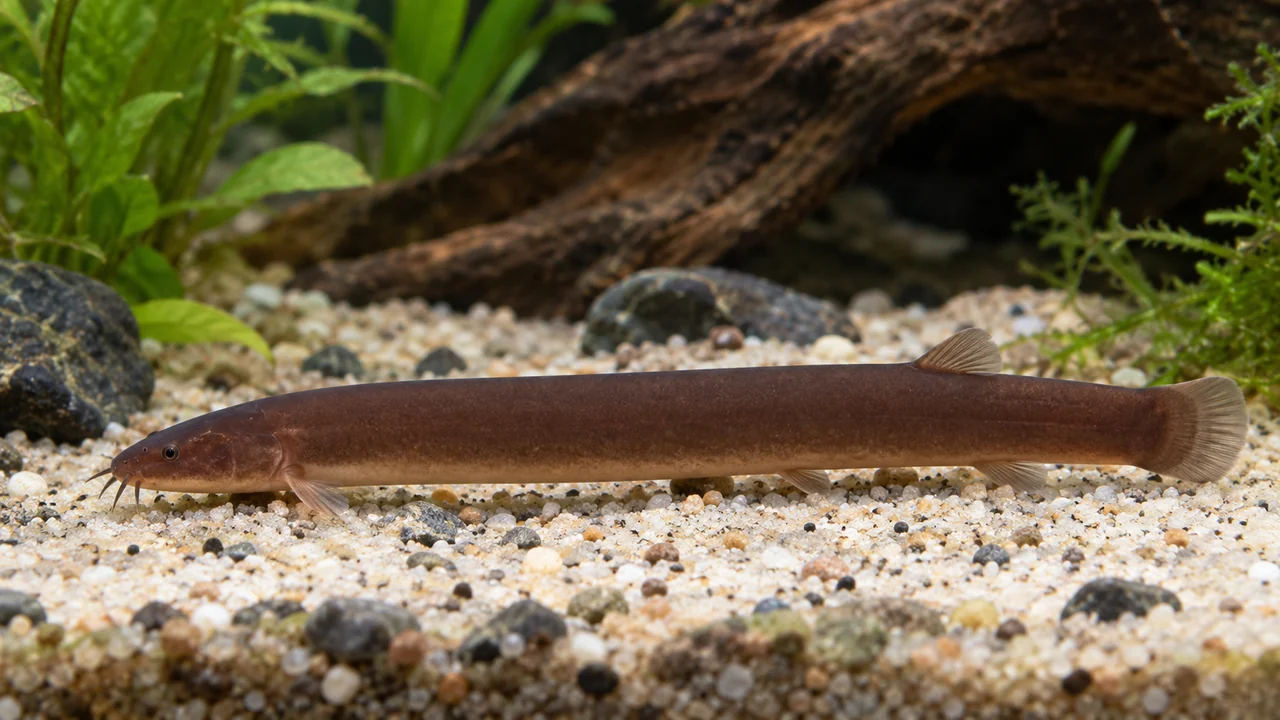
- Adult size
- Approximately 8 cm standard length in species guidance; allow additional room for a group to search.
- Maintenance water
- Around 23–25°C, pH 5.5–7 and 2–8°dGH, with stable preparation and mature filtration.
- Group and floor
- At least six; a 75–80 × 30 cm or larger base gives useful area beyond the published 60 × 30 cm baseline.
- Identification
- Plain brown to reddish-brown, without the dark transverse saddles of semicincta; similar plain species need care.
- Feeding
- Small sinking complete food and suitable invertebrates delivered at several lower stations.
- Breeding
- A reported aquarium recruitment event is not a controlled recipe or a reason to reproduce its unusual water values.
Plain brown is a starting point
Pangio oblonga is the accepted Java or Black Kuhli Loach, originally Cobitis oblonga. Acanthophthalmus javanicus is a historical name associated with it; older gender endings also occur in search material. The body is plain chocolate to cinnamon, sometimes paler or pinkish, with no banded semicincta pattern.
Not every plain Pangio can be identified by colour alone. Similar fishes differ in proportions and other characters, and genetic work indicates hidden diversity within the broadly used oblonga name. Keep the actual source record and qualify a doubtful identification rather than certifying a locality from a brown body. A generic chocolate-loach label is useful for shopping, not a complete taxonomic diagnosis.
Java origin and a wider qualified range
The name was described from the Bogor area of Java, while current accounts also report Sumatra, Borneo, Peninsular Malaysia and Thailand. That broad usage may include closely related lineages. It does not justify claiming a named Java collection site for ordinary trade stock without supporting information.
Shallow sheltered waters, soft substrates, roots and leaf-rich areas provide useful aquarium cues. Build connected lower cover with visible searching patches. The goal is a stable home for several slender fish, not a replica of one narrow ditch or a tank whose entire floor is hidden beneath material that cannot be inspected.
A group needs searchable area
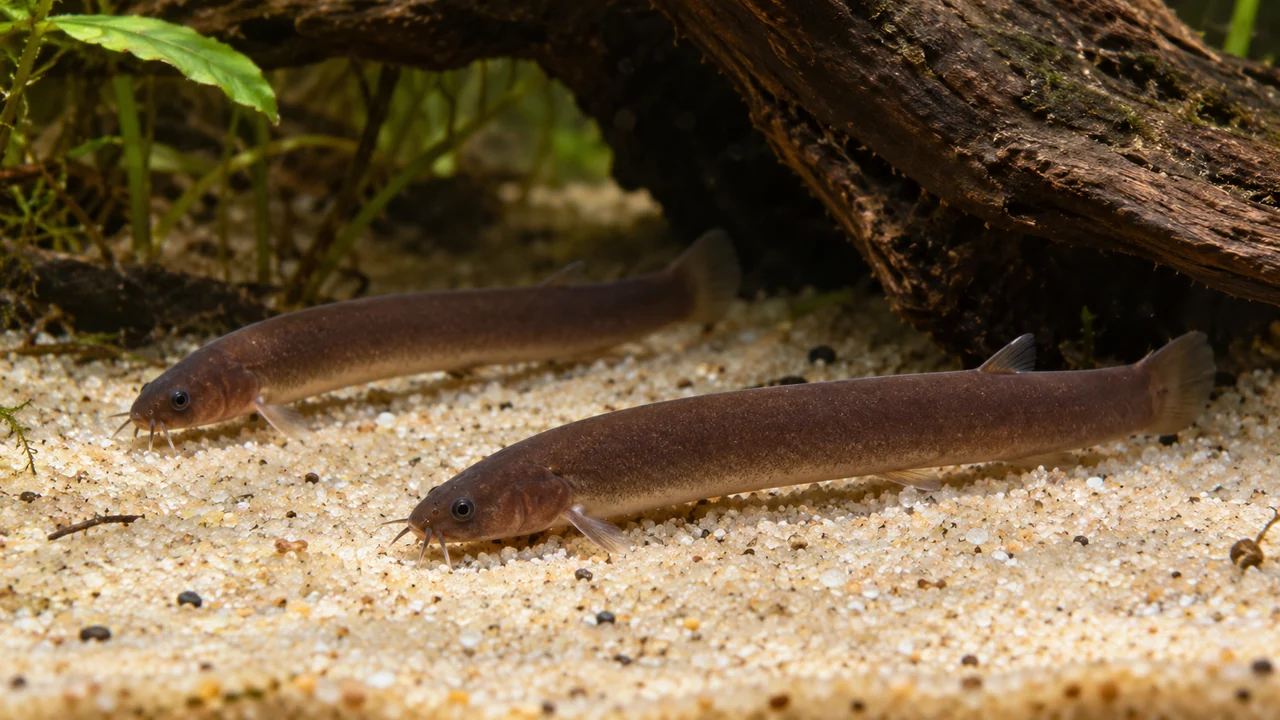
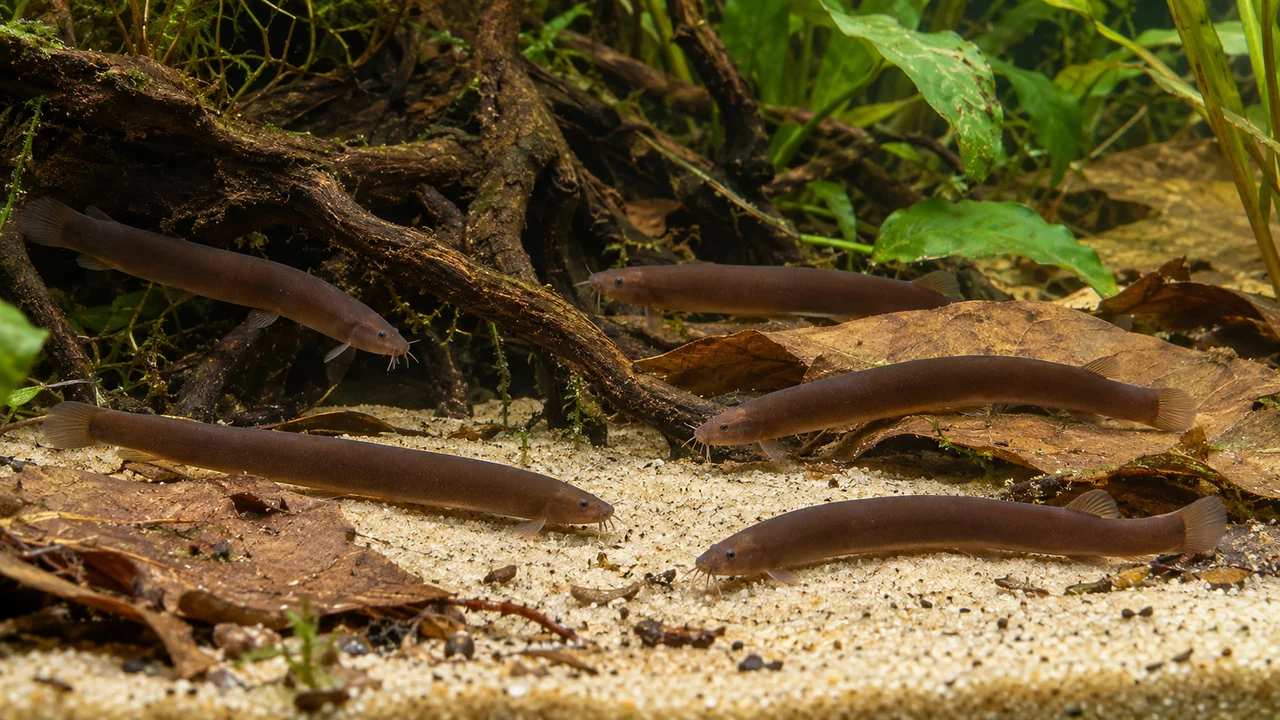
Keep at least six and plan around adult bodies approximately 8 cm long. These fish may share one resting nook, but should also have routes to several feeding areas. A 75–80 × 30 cm or larger base is a useful practical plan beyond the published 60 × 30 cm baseline, with the final stocking depending on all occupants and usable floor.
Check whether roots divide the bottom into accessible spaces or fence the animals into one cramped edge. Several suitable retreats are preferable to one attractive hole. Keep some sand visible from the front for body-condition checks and feeding. Adding a different Pangio species does not automatically satisfy the social and observation needs of the original group.
Secure the sand and the equipment
Use smooth fine sand and stable roots, with heavy objects supported so burrowing does not create a collapse risk. Avoid sharp rubble, narrow dead-end ornaments and loosely balanced stacks. The fish’s flexible body should not be used as proof that it can safely reverse out of any opening it enters.
Cover the aquarium carefully, including gaps around pipes and cables. Protect filter intakes and check spaces inside guards and housings against the smallest fish. Java Loaches can explore equipment or leave the water, especially during settling. A lid and intake plan is an essential part of bottom-fish care, not merely an accessory for surface species.
Use a measured maintenance routine
A practical target is 23–25°C, pH 5.5–7 and 2–8°dGH. These values overlap semicincta because the species guidance overlaps; they are not evidence that the fish share every ecological or reproductive requirement. Prepare replacement water consistently and respect the source stock’s previous conditions during acclimation.
Maintain established biological filtration with circulation and surface exchange, without blasting every lower refuge. Keep ammonia and nitrite undetectable and inspect places where waste gathers. A calm floor should not become an oxygen-poor pocket. Watch how water and food move around roots rather than assuming the filter rating alone describes the conditions experienced by a resting loach.
A deliberate ration at the bottom
Offer suitable small sinking complete foods and regular appropriately sized live or frozen invertebrates. Place portions at several lower stations when the fish are willing to emerge. Observe searching and intake. One rapidly emptied tablet does not establish that all six loaches fed; another bottom fish may have controlled it.
Do not rely on scraps left by the upper community or call the group a waste-removal crew. Follow the smallest and least confident fish, adjust delivery and remove excess food. Dense leaf margins can be useful, but an inaccessible food pile creates a maintenance problem rather than a self-sustaining diet. Body condition over time is a better measure than activity around the first meal.
If the fish accepts prepared sinking food, Artemia SuperSoft Fish Food is a soft-food option to compare with the ration above. This listing is the 1.4–2.2 mm grade: use it only where the actual fish can swallow the pieces readily, and keep portions accessible to quieter individuals.
Company, hiding and normal observation
Shared cover and periods out of sight are normal aspects of Pangio behaviour. Provide shade and calm observation opportunities rather than stripping shelter to make every animal visible. Check the group under subdued light and confirm that each fish remains well conditioned and can reach food without repeated interference.
Quiet companions with suitable mouths and compatible water are better than predators or very competitive territorial bottom dwellers. Eggs and tiny young fish may still be eaten. If one loach spends its time inside equipment or repeatedly races around the surface, inspect environmental or social causes instead of treating every unusual movement as an amusing species trait.
What the breeding report actually supports
There is a reported aquarium event in which young attributed to this species were discovered among coarse substrate, without observed courtship or spawning. The account’s unusually hard alkaline water does not establish an optimal maintenance or breeding requirement, and the absence of controlled observation limits the conclusions that can be drawn.
Do not recreate sharp or coarse substrate merely because fry happened to survive there. For an intentional project, maintain identified stock, good condition, mature safe surfaces and a record of actual changes. Prepare protected filtration and appropriate fine food if young appear. Avoid promising a yield or a calendar from one uncontrolled event; successful adult keeping is not incomplete because a brood has not been produced.
Botanical structure and first checks
Prepared leaves and suitable low wood can form shaded lower edges. Keep portions manageable, retain open feeding patches and clean accumulated waste without dismantling every refuge. Botanical surfaces do not remove the need for complete nutrition, stable water and physical safety.
For loss of condition, observe the quieter fish at feeding. For skin or barbel damage, inspect hidden material and water quality. For a missing animal, check protected equipment calmly before moving heavy structures. For restless surface movement, test water and review oxygen, recent maintenance and lid gaps. Record the sequence so a specific correction can be assessed instead of changing every part of a previously workable aquarium.
For low cover beside the searchable sand, compare Dried Arjuna Leaves (Kumbuk) – Natural Aquarium Leaf Litter with a small selection from Blackwater Leaf Box – Leaf Litter Starter Mix. Scatter material around open feeding patches rather than creating narrow tubes through which a loach must squeeze.
Further reading and sources
Identity and natural-history sources are distinguished from aquarium husbandry. Recommended care is not a set of experimentally established survival limits; breeding conditions may differ from adult maintenance.
- Seriously Fish — Pangio oblonga — Species-specific husbandry, adult scale, social arrangements and reproduction. Read explanatory water notes, not just summary numbers.
- Kottelat (2012), Conspectus cobitidum — Primary taxonomic inventory for loach names and historical combinations, separate from aquarium husbandry.
- Bohlen et al. (2011), phylogeny of Pangio — Primary molecular study, indexed abstract consulted; multiple lineages caution against identifying every similar trade fish from colour alone.