Fish · Adolfo’s Cory
Adolfo’s Cory — Hoplisoma adolfoi: Habitat and Care
A social sand-foraging catfish with a gold nape, dedicated feeding needs and a modern scientific name; colour alone cannot reliably separate it from duplicareum.
- Accepted combination
- Hoplisoma adolfoi (Burgess, 1982); Corydoras adolfoi remains a useful older search name.
- Adult size
- Around 5.7–6 cm standard length; leave additional room for fins and movement.
- Practical temperature
- 22–25°C is a useful routine plan within published 20–26°C guidance.
- Water plan
- Soft water, around pH 5.5–7 and 1–5°dGH, prepared and changed consistently.
- Social and space plan
- At least six of the same species; plan an 80–100 cm long aquarium with a broad, accessible sand floor.
- Feeding
- Dedicated small sinking food; not a substitute for cleaning or a fish that survives on leftovers.
The accepted name and the familiar older one
Hoplisoma adolfoi is the current combination following the modern reorganisation of corydoradine catfishes. Corydoras adolfoi remains common in shops and older literature and is retained here as a search alias, not a second species article. The change of genus does not mean that an existing fish suddenly needs a different aquarium or diet.
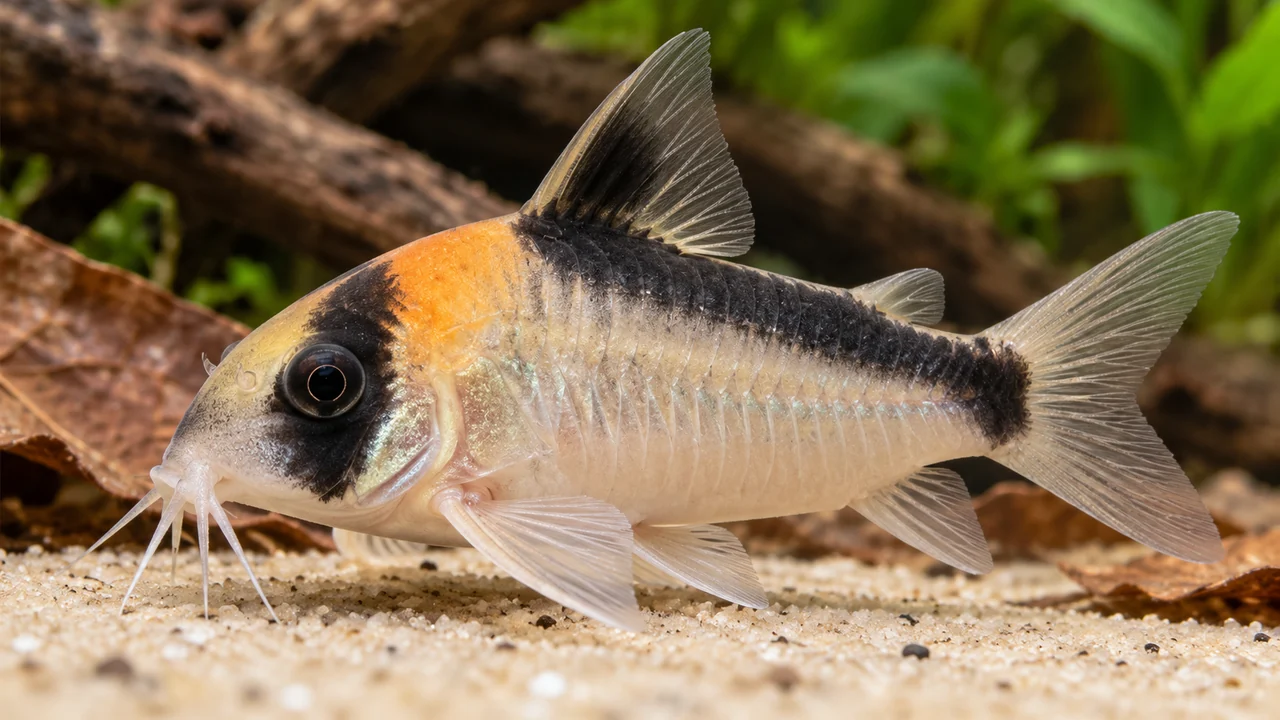
Look for a short, rounded snout, pale armoured body, black eye mask and a gold-orange nape area, with a dark band along the upper back. Closely similar H. duplicareum is difficult to separate reliably from colour alone. Band width varies and is not a conclusive test. Specialist diagnostic accounts discuss pectoral-spine serrations that are not safely established by inspecting an ordinary shop photograph. Ask for source information rather than inventing certainty.
Rio Negro origin and useful habitat cues
The species is associated with the upper Rio Negro region of Brazil, with the original locality near São Gabriel da Cachoeira. Do not extend the distribution to every nearby drainage simply because another similarly marked cory occurs there. Soft-water habitat context supports a careful water plan, but is not a reason to pour acid into an occupied community aquarium.
The useful physical cues are a soft foraging floor, sheltered edges and clean, oxygenated water. Leaf litter can provide cover around the margins, but the aquarium must still contain open feeding routes. A display carpeted entirely in large pods and rough pieces may look natural while leaving these small catfish little accessible substrate on which to search for food.
Give a group a proper floor
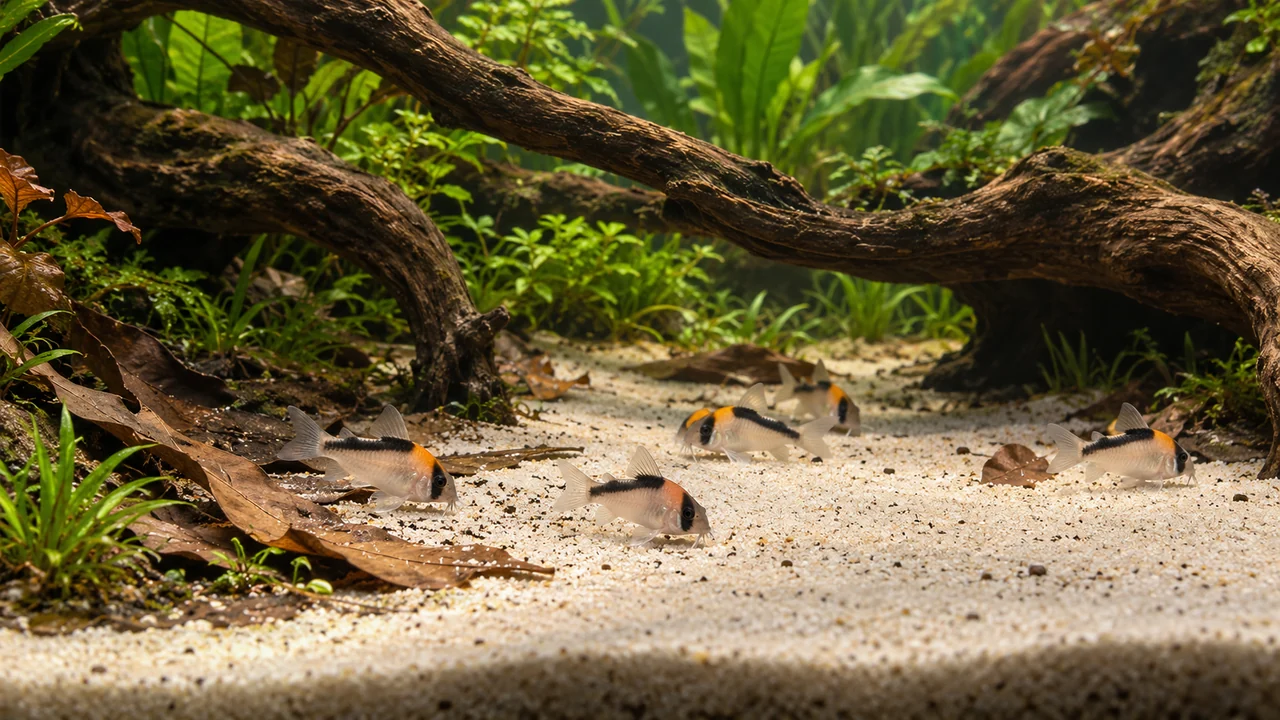
Plan for at least six of the same species, with more possible where the floor, filtration and feeding capacity allow it. A mixture of one or two individuals from several similar species is not an equivalent social group. Choose an aquarium around 80–100 cm long with a broad base, making the longer option particularly useful in a community with other bottom occupants.
Use fine, smooth sand and leave several open patches where the group can forage together. Keep wood stable and provide broad passages that remain safe at adult size. Inspect holes and forks rather than assuming that any pod is a useful shelter. Access to the water surface must remain unobstructed, and maintenance routes should let you remove uneaten food without dismantling the entire arrangement.
Moderate warmth, oxygen and stable water
A routine target around 22–25°C sits comfortably within the published 20–26°C husbandry range. It does not make this species an automatic partner for a permanently 30°C discus aquarium. Soft water around pH 5.5–7 and approximately 1–5°dGH provides a useful working plan, with the actual supplier’s conditions and a gradual transition considered before purchase.
Use mature biological filtration and effective gas exchange, with enough circulation to prevent stagnant pockets beneath cover. Ammonia and nitrite should be undetectable. Keep the sand surface clean without continually stripping the whole aquarium. Periodic quick trips to the surface can be normal air-gulping behaviour in corydoradines; repeated unusual urgency, rapid gill movement or many fish crowding the outlet still warrants immediate water and oxygen checks.
Feed the catfish deliberately
Offer small sinking granules or tablets of suitable composition and supplement with appropriately sized frozen or live invertebrate foods. Break a tablet into usable portions where necessary and place food where the group can reach it. These are small omnivorous catfish with their own feeding requirements, not a service that converts every other fish’s waste into nutrition.
Watch actual intake. Fast midwater fish or larger bottom feeders may remove the ration before the corys arrive. Several small feeding positions can help without leaving a blanket of food to rot. Check body condition and the barbels, and remove persistent leftovers. Algae, leaf biofilm and scraps that happen to land on the bottom are not a dependable complete diet for the group.
If the fish accepts prepared sinking food, Artemia SuperSoft Fish Food is a soft-food option to compare with the ration above. This listing is the 1.4–2.2 mm grade: use it only where the actual fish can swallow the pieces readily, and keep portions accessible to quieter individuals.
Barbels, shelter and social behaviour
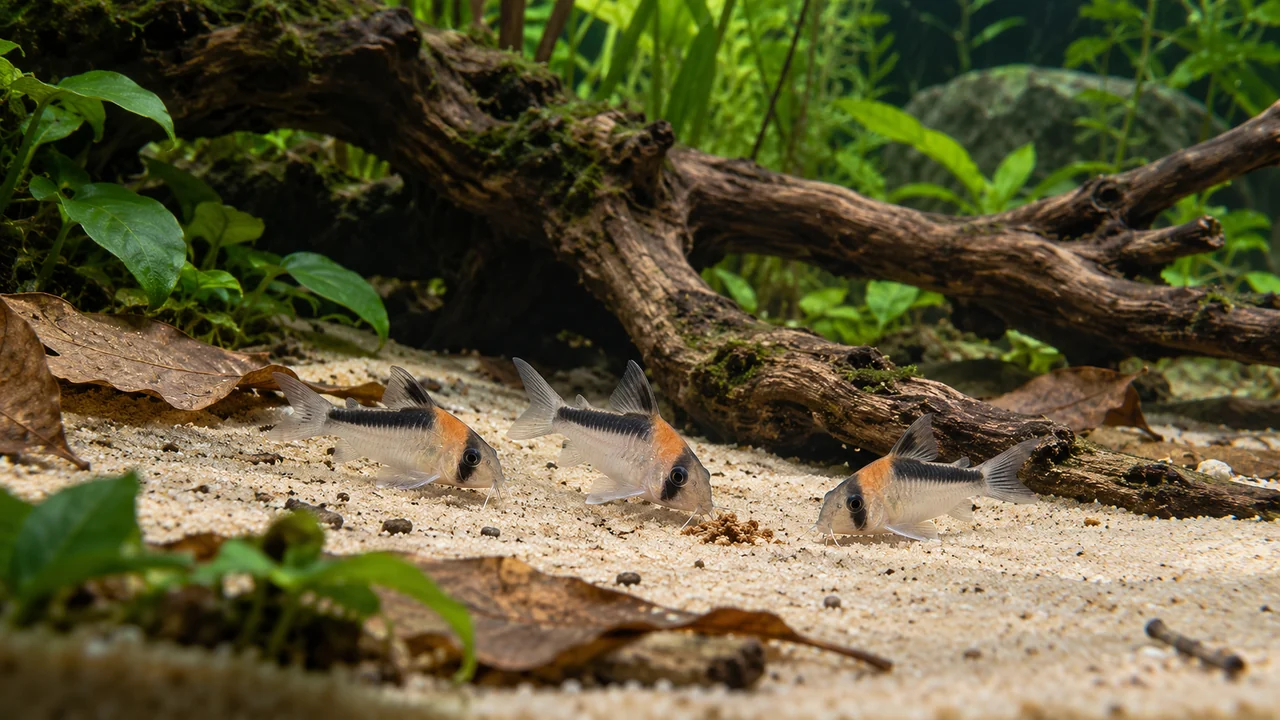
Fine barbels help the fish explore the substrate. Damage or erosion should prompt a review of sand cleanliness, sharp surfaces, accumulated waste and health rather than an automatic assumption that all sand is safe or all gravel is harmful. A smooth substrate can still become dirty, while an inaccessible food trap beneath wood can undermine an otherwise sensible layout.
Choose peaceful companions with overlapping water and temperature needs. Large predatory fish, persistent harassers and breeding cichlids defending the entire floor can make even a well-filtered aquarium unsuitable. Give the group cover with wide exits and observe whether all individuals emerge to feed. Brief resting beneath wood is normal; permanent hiding accompanied by poor intake or damage needs attention.
Breeding and the small-food stage
Adolfo’s cory is an egg-scattering corydoradine rather than a cave-guarding cichlid. Courtship can include the characteristic T-position, with eggs placed on glass, fine-leaved plants or other surfaces. Adults do not provide the prolonged guarding care of the ram or discus. Eggs and fry are vulnerable in a normal community, including to the adults themselves.
A deliberate rearing project needs protected filtration, suitable water and tiny foods matched to the fry’s size once feeding begins. Removing eggs creates separate responsibilities for cleanliness and observation. Do not copy extreme repeated cold-water changes or chemical recipes into routine adult maintenance simply because they appear in a breeding account. Establish a healthy, well-fed group before deciding whether a dedicated rearing arrangement is appropriate.
Botanicals around an accessible substrate
A few prepared leaves and smooth wood can break up the aquarium’s edges and create useful shaded resting places. Leave the main feeding floor open and avoid a deep layer that hides waste or makes it impossible to see the fish. Choose openings with the armoured adult body and spines in mind; a narrow exit can be more dangerous than an apparently inviting entrance.
Tannins are not a treatment for damaged barbels or breathing problems. Measure water conditions and review organic load independently of colour. Introduce suitable materials gradually and keep circulation around the lower aquarium. When a leaf begins to fragment, decide whether it remains useful cover or is trapping food in a place you cannot maintain. Natural decomposition does not remove the need for observation.
For the edge of the open feeding floor, compare Dried Bodhi Leaves (Ficus religiosa) – Aquarium Leaf Litter with selected material from Blackwater Leaf Box – Leaf Litter Starter Mix. Keep the smooth substrate and the group’s route to food visible; use botanical detail around those working spaces.
First checks and safe handling
For poor feeding, rapid breathing or unusual isolation, check temperature, ammonia, nitrite, oxygenation and whether the group reaches its own food. Inspect the substrate and hidden areas for waste. Compare behaviour with the other fish and note recent introductions or maintenance changes. Persistently abnormal condition requires appropriate aquatic advice rather than an untested salt or medication routine.
Use care when moving armoured catfish because their fin spines can catch in fine netting. A suitable rigid container can reduce snagging when practical; do not pull a trapped fish through the mesh. Keep handling brief and deliberate. A well-planned group, accessible sand and reliable meals are more valuable to everyday care than treating this species as a decorative cleaning accessory.
Further reading and sources
Identity and natural-history sources are distinguished from aquarium husbandry. Recommended care is not a set of experimentally established survival limits; breeding conditions may differ from adult maintenance.
- Dias et al. — Phylogenomic analyses in the complex Neotropical subfamily Corydoradinae — Primary modern classification; accepted Hoplisoma combination cross-checked with current taxon records.
- FishBase — Hoplisoma species list — Current combination and standard-length context.
- Seriously Fish — Corydoras adolfoi — Species-specific husbandry, adult scale, social arrangements and reproduction. Read explanatory water notes, not just summary numbers.
- ScotCat — Hoplisoma adolfoi — Named species account with updated nomenclature and species-comparison context.
- Aquarium Glaser — Hoplisoma adolfoi and duplicareum — First-hand trade account highlighting identification difficulties; no merger of the two accepted species is assumed.