Fish · Duplicate Cory
Duplicate Cory — Hoplisoma duplicareum: Habitat and Care
A gold-naped, broad-striped Rio Negro catfish requiring its own social group and meals; compare Adolfo’s cory without treating band width as a definitive identification test.
- Scientific identity
- Hoplisoma duplicareum; the familiar older combination is Corydoras duplicareus.
- Adult scale
- Plan for a fish around 5–5.5 cm, with females generally fuller and larger.
- Routine temperature
- 23–25°C is a useful maintenance target within broader published guidance.
- Water plan
- Soft water around pH 6–7 and 2–5°dGH is a conservative starting plan; established-stock reports also include harder water.
- Social and space plan
- At least six of the same species; an 80 cm long aquarium with a broad sand floor is a practical group plan.
- Food
- Dedicated small sinking food and suitable invertebrate supplements, not leftover waste.
One species, two familiar spellings
Hoplisoma duplicareum is the current combination; Corydoras duplicareus is the older name still common in shops and breeding records. The change from duplicareus to duplicareum accompanies the generic reassignment and spelling agreement. It does not create two species or mean that an existing fish needs a different diet overnight. This guide keeps one canonical profile and retains the older combination for searching.
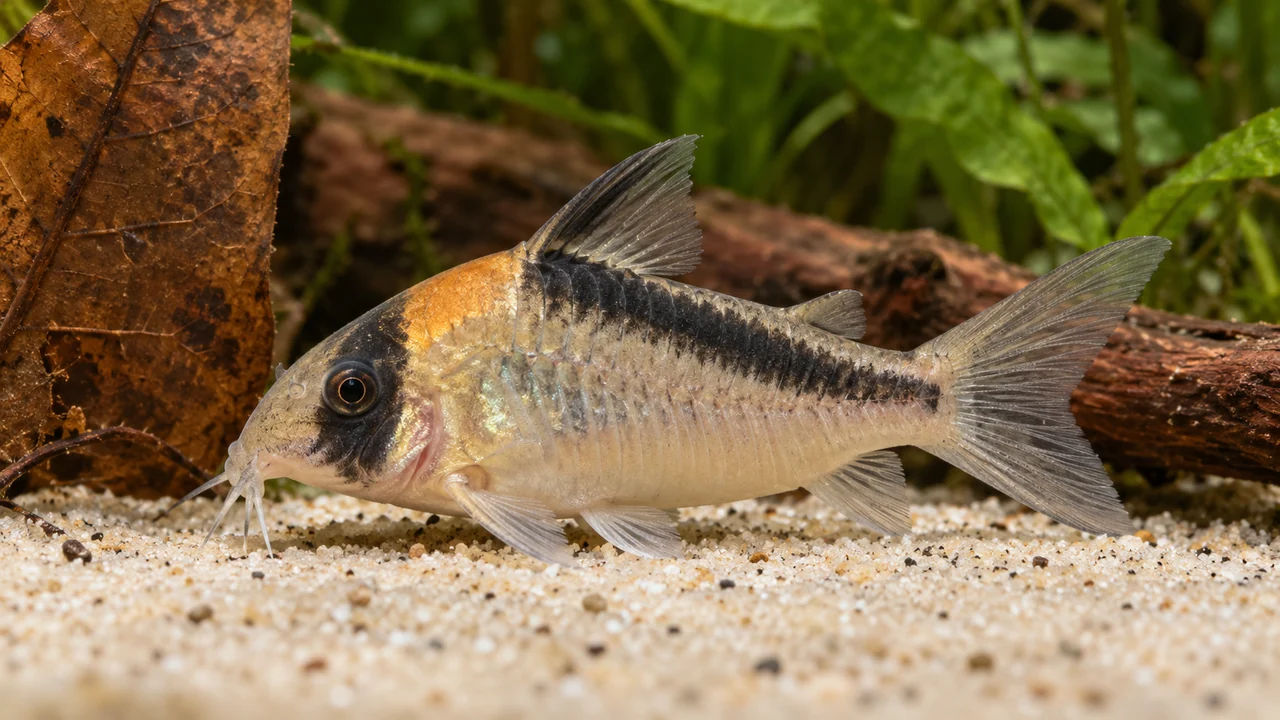
The fish has a pale armoured body, dark eye mask, gold-orange nape and a broad oblique dark band along the upper back. It is very similar to H. adolfoi. The back band often looks broader and the nape more intense, but both vary. A single well-lit photograph is not enough to certify every fish offered under either name.
Compare Adolfo’s cory carefully
Specialist descriptions distinguish duplicareum by serrations on the posterior edge of the pectoral-fin spine, absent in adolfoi. These are difficult to see without suitable examination. Do not handle a living fish roughly or claim that a normal aquarium portrait reveals microscopic detail. Supplier provenance and reliable identification are more useful than repeatedly judging the width of a moving fish’s black band.
Trade observations also question how consistently colour forms and reported spine characters separate aquarium shipments. That uncertainty does not justify merging the currently recognised species or relabelling the established Adolfo’s article. Keep a group sold and identified consistently, record the source and use the comparison as a reason for care in purchasing rather than a promise that colour alone settles the question.
Upper Negro context and a usable floor
The documented origin is a restricted part of the upper Rio Negro system in Brazil, associated with the Poranga locality. River-basin origin is useful context for soft-water planning and sheltered margins, not proof that every captive fish needs the same extreme field pH. Ask about the actual stock’s recent conditions, feeding and breeding history before preparing its new aquarium.
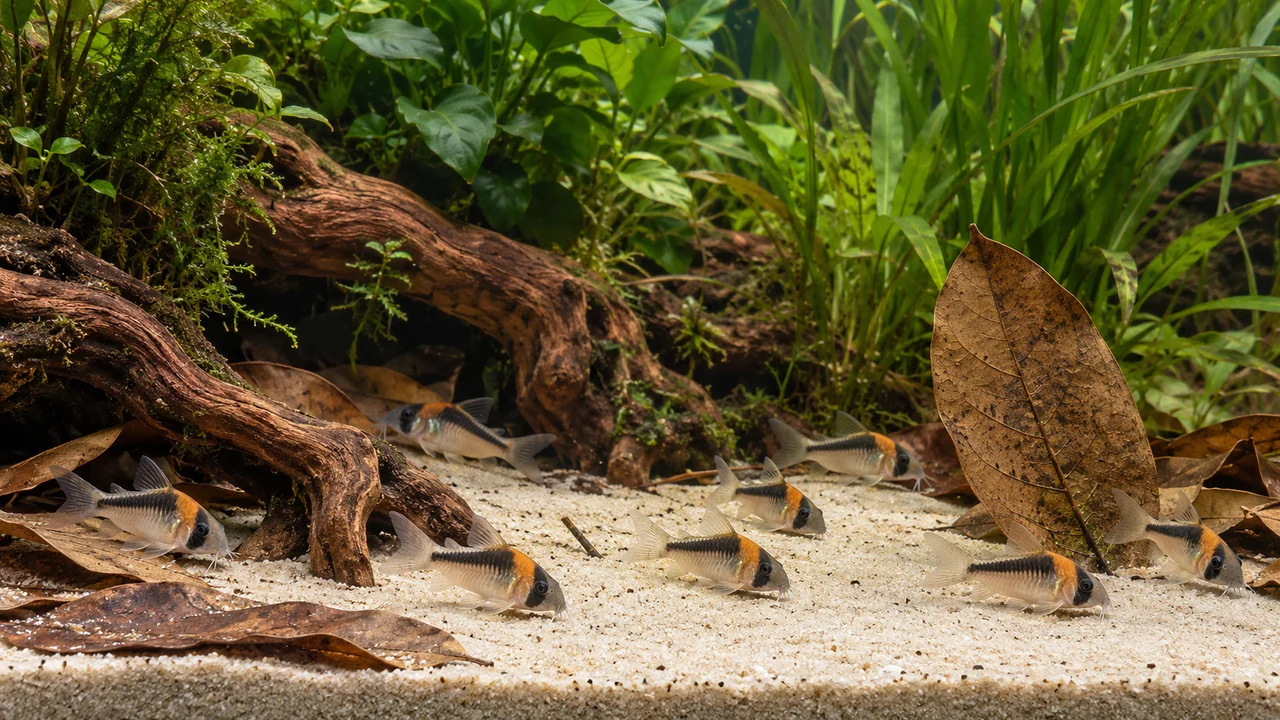
For a group of at least six, an aquarium around 80 cm long with a broad base provides useful foraging and retreat space. A named keeping account describes a smaller roughly 60 × 38 cm group aquarium; the larger proposal here deliberately leaves more room for maintenance and companions. It is a planning recommendation, not a laboratory minimum or assurance that any community combination will work.
Choose stable water from the evidence
A routine 23–25°C target is supported by Chris Ralph’s specialist account. Published water advice differs: the species summary favours very soft acidic water, while the named keeping account reports fish maintained at pH 6–7.2 and substantially greater hardness. For unfamiliar stock, soft water around pH 6–7 and 2–5°dGH is a conservative plan, with documented acclimation history taking priority over abrupt changes.
Use mature filtration, effective gas exchange and gentle circulation along the floor. Ammonia and nitrite should be undetectable. Match replacement water carefully and adjust maintenance to feeding, nitrate trends and visible debris. An occasional surface air gulp can be normal cory behaviour; repeated unusual urgency or rapid gill movement still calls for immediate oxygen and water checks. Air breathing is not permission to neglect aeration.
Sand, shelter and shared feeding access
Fine smooth sand makes small food items accessible to the mouth and barbels. Leave several open patches rather than covering the entire floor with large pods. Low wood and plants can screen the margins, provided the group can pass through without narrow traps. Secure hardscape and inspect both entrance and exit at adult size. An attractive opening is not necessarily a safe shelter.
A few prepared leaves can provide cover around the edges while the main feeding area stays visible. Keep access for removing leftovers beneath wood and around plants. Avoid a layout in which the only meal falls into one recess or a larger bottom fish controls every passage. The most useful arrangement lets you see the group feed and rest without dismantling its shelter.
For the edge of the open feeding floor, compare Dried Mulberry Leaves – Aquarium Shrimp Food & Leaf Litter with selected material from Bellani Pumpkin Cups – Cut Natural Botanical Cups. Keep the smooth substrate and the group’s route to food visible; use botanical detail around those working spaces.
Feed deliberately and watch the mouth
Offer an appropriate complete sinking food in small granules or broken portions, with suitable frozen or live invertebrate foods for variety. The fish should be able to locate and swallow the ration without struggling with an oversized hard tablet. A companion’s uneaten scraps are not a reliable meal plan, and feeding the aquarium heavily does not prove that the corys have eaten.
Distribute manageable portions across accessible patches if faster fish intercept the food. Observe body condition and the barbels, including individuals remaining behind cover. Persistent leftovers should be removed and the next portion adjusted. Biofilm and leaf-associated growth may add foraging opportunities, but they do not replace balanced feeding. A group described as bottom cleaners still needs the same attention to nutrition as the display fish above it.
If the fish accepts prepared sinking food, Artemia SuperSoft Fish Food is a soft-food option to compare with the ration above. This listing is the 1.4–2.2 mm grade: use it only where the actual fish can swallow the pieces readily, and keep portions accessible to quieter individuals.
Groups and compatible neighbours
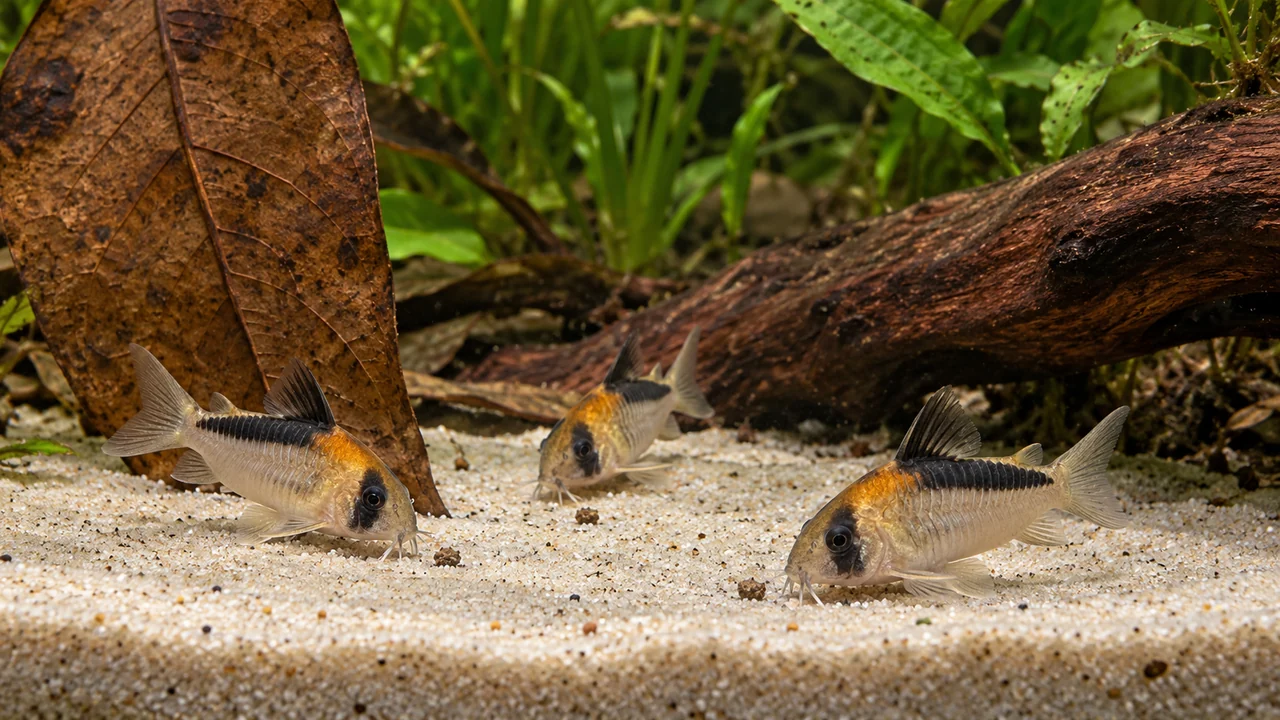
Maintain a same-species group rather than one or two fish collected as an assortment of similar-looking corys. Six is a useful starting social plan; more requires sufficient floor, food access and filtration. A well-fed group may forage together and then rest separately. Temporary separation within the aquarium is different from persistent isolation accompanied by poor condition or failure to feed.
Choose peaceful companions that suit the actual temperature and water. Breeding cichlids can defend the same floor even if their ordinary behaviour seems calm. Large predatory fish or persistent harassers are unsuitable, and busy bottom feeders may outcompete the corys without injuring them. Check how the whole aquarium uses the lower space before adding another animal merely because it is described as community-safe.
Breeding and the change to fry care
Aquarium breeding has been recorded. Courtship follows the corydoradine pattern, with a T-position and adhesive eggs placed on suitable surfaces such as glass or fine vegetation. Adults do not provide the extended guarding care of a dwarf cichlid. A group showing increased activity after maintenance has not necessarily spawned, and a few eggs do not guarantee a surviving brood.
Deliberate rearing requires protected filtration, clean well-oxygenated water and food small enough for newly feeding fry. Consider a dedicated arrangement where eggs and tiny young can be observed without community predation or competition. Do not import repeated large cold-water changes or routine chemical dosing into normal maintenance just to provoke spawning. Healthy adults, a suitable diet and steady water come before a breeding experiment.
First checks and safe movement
If a fish becomes withdrawn, stops feeding or breathes rapidly, check temperature, ammonia, nitrite, oxygenation and access to its own ration. Inspect hidden sand and the underside of wood for waste. Damaged barbels need an assessment of cleanliness, sharp surfaces and health, not an automatic change to a darker water colour or an untested medication combination.
Fin spines can catch in netting. Move the fish calmly and use a suitable rigid container where practical; do not pull an armoured catfish through mesh when it snags. Keep handling brief. Prepared leaves and wood have useful structural roles, but neither replaces water management or qualified assessment when a persistent health problem remains unexplained.
Further reading and sources
Identity and natural-history sources are distinguished from aquarium husbandry. Recommended care is not a set of experimentally established survival limits; breeding conditions may differ from adult maintenance.
- Dias et al. — Corydoradinae classification — Primary modern classification; accepted combinations and spelling checked against current taxon records. Older Corydoras names are aliases, not additional species.
- FishBase — Hoplisoma species records — Current scientific combinations; recorded specimen lengths are distinguished from rounded aquarium planning sizes.
- Seriously Fish — Hoplisoma duplicareum — Species-specific husbandry, adult scale, social arrangements and reproduction. Read explanatory water notes, not just summary numbers.
- ScotCat — Hoplisoma duplicareum — Chris Ralph — Named specialist account of identification and aquarium care; historical breeding methods are not universal maintenance instructions.
- Aquarium Glaser — adolfoi and duplicareum comparison — First-hand trade observations highlight identification uncertainty; this article does not merge the accepted species.