Botanical Aquascaping · The Rio Xingu Stone Channel
The Rio Xingu Stone Channel
Create a clear-water mineral channel with secure rockwork, shaded crevices and deliberate oxygenation; leaves are optional and never the main substrate.
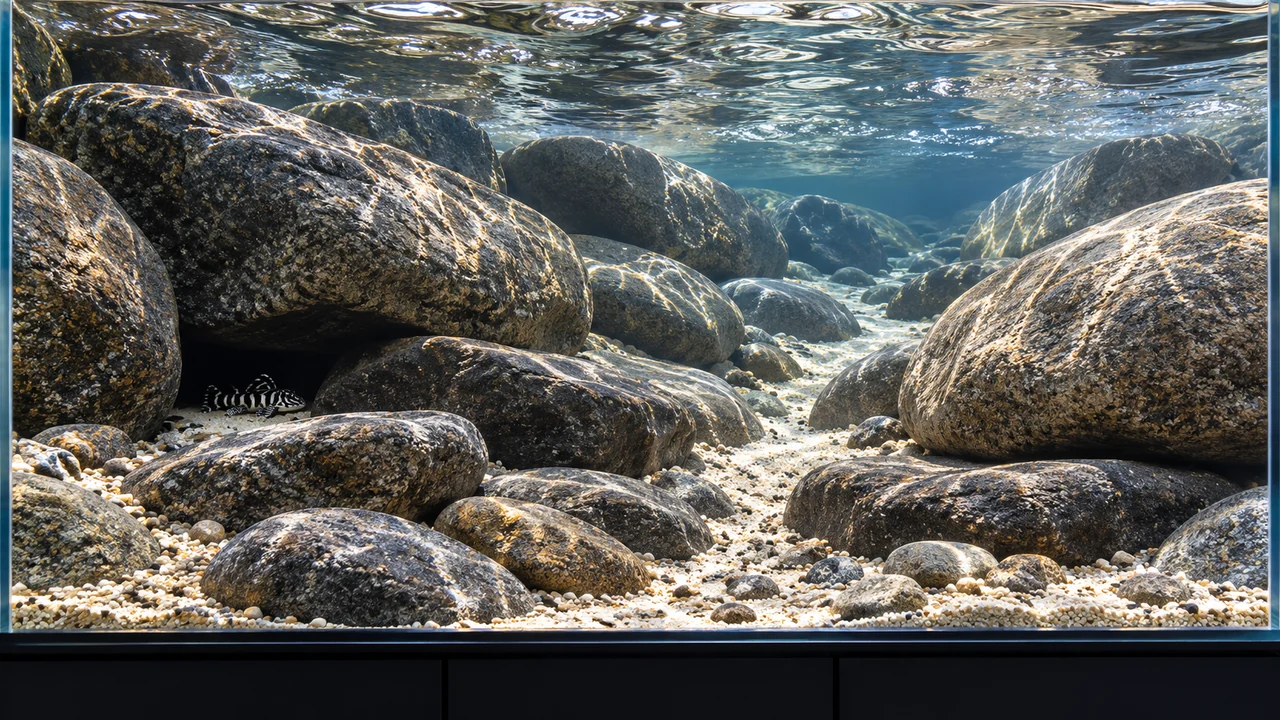
- Suggested shell
- 120 × 45 × 45 cm; check stand and tank limits before installing heavy rock.
- Habitat direction
- A clear-water rocky-channel interpretation, not Amazonian leaf-litter blackwater.
- Equipment
- Mature biological and mechanical filtration, guarded circulation, surface agitation and aeration.
- Stocking direction
- Species-specific current, temperature, shelter and food requirements take precedence over appearance.
Begin with rock, water and open routes
The Xingu belongs to the Amazon basin, but that does not make its rocky channels acidic leaf-litter blackwater. Studies of the middle river describe clear water, rocky structure and fish communities influenced by hydrology and oxygen among other factors. This project takes the stone-channel direction: stable rounded boulders, narrow sandy seams, dark crevices and a clearly open route through which water can move.
It is a scaled aquarium interpretation, not a claim to reproduce the whole river or its seasonal extremes. Choose a particular appropriate species before setting temperature and flow. Different Xingu fish use different microhabitats, and many become far too large for a home display. The attractive mineral composition should remain useful even without a conspicuous fish sitting in every cave.
1. Plan the weight and the service route
A 120 × 45 × 45 cm shell offers room for staggered low ridges rather than one unstable rock pile. Confirm what the aquarium manufacturer permits beneath heavy rock and how loads must be distributed. Check the stand and floor before acquiring boulders. Choose manageable aquarium-safe stones, avoiding sharp projections and uncertain contaminated material. Test any rock likely to alter water chemistry before committing to it.
Reserve access to the filter intake, heater and circulation pump. Use guards suitable for the smallest planned inhabitants. Mechanical filtration must be easy to service because food and waste can lodge between stones even when the front looks clean. Provide effective biological filtration independently of the pump that produces visible current. Moving water is not proof that the aquarium is cycled or has enough oxygen at every shelter.
2. Seat the rockwork before adding the seams
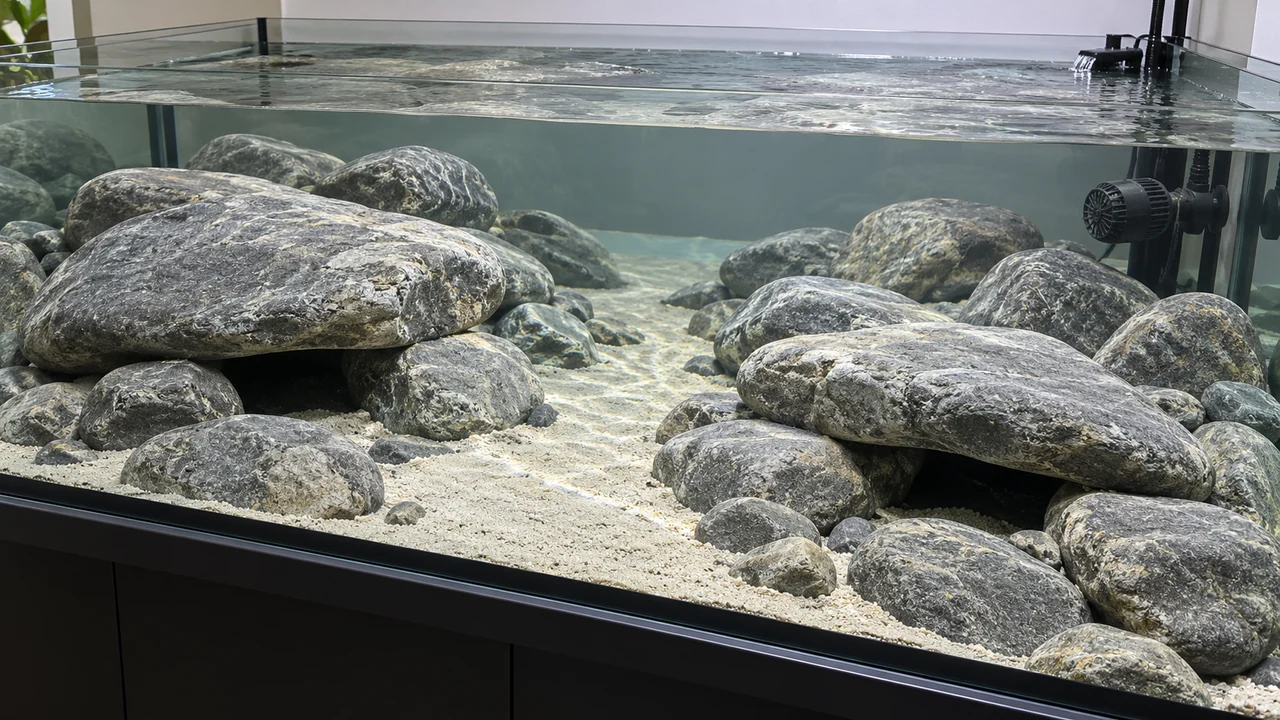
Place the major stones on secure, appropriate supports before filling around them with sand. Keep the ridges low, broad and interlocking through stable contacts; do not balance a heavy stone on a decorative point. Push each assembly gently from several directions while empty. Avoid loading the glass with an unstable stack or relying on buried loose sand to hold the structure in place.
Arrange separate crevices with entrances that remain observable and accessible. For cave-using fish, the entrance, interior size and territorial spacing must suit the actual species, not a photograph. Add a modest amount of rinsed sand or smooth small gravel in the seams without burying the cave openings. Leave an uninterrupted main channel and a reachable route behind the rear ridge.
3. Test circulation through the structure
Fill gradually and begin with adjustable circulation directed along the open channel. Look for surface agitation and exchange around the rocks, including the sheltered spaces. A suitable pump should have a secure guard and mounting. Do not position a jet so that a fish must fight it continuously to leave its cave. Provide lower-velocity resting areas connected to fresh water, not sealed dead pockets.
Observe where small particles settle and whether sand is continually lifted. Change outlet angle or rock spacing before simply increasing power. Check temperature across the aquarium and plan additional aeration, especially with warm-water inhabitants. Keep pump and filter cleaning separate enough to preserve established biological media. Design the pipe route so a failed or obstructed circulation pump does not also remove all biological filtration.
4. Keep leaves and wood subordinate
This is one of the projects where botanical restraint may mean omitting leaves completely. A deep leaf carpet would block crevices, retain food and add organic demand in a design intended for clean, oxygenated moving water. If a small piece of wood is used, secure it away from the principal channel and confirm that it provides a useful shelter boundary rather than an obstruction.
A single prepared leaf in an accessible low-flow margin can be monitored if it suits the inhabitants, but it is not required to make the aquarium part of a botanical collection. Do not add tannins to force an amber appearance or use peat to manufacture generic Amazonian acidity. The ecological value of this design comes from the right physical structure and water management, not from the quantity of plant material it contains.
5. Let limited planting preserve the channel
Open stone can be the finished surface. There is no requirement to fill the gaps with plants, and a dense carpet would reduce feeding access and hide waste. Allow appropriate mature surface growth to develop while keeping the glass and critical equipment clean. Do not describe that growth as a complete food supply for every fish that happens to rest on rock.
If you choose a habitat-style planted margin, use plants able to cope with the selected flow, temperature and light and keep their roots out of caves and intakes. Non-regional cultivated plants make it a practical interpretation rather than a strict Xingu biotope. Anchor them correctly and leave the main route open. Bright mineral highlights can be achieved with moderate lighting; excessive light is not a substitute for oxygenation.
6. Assess zebra plecos as a specialist option
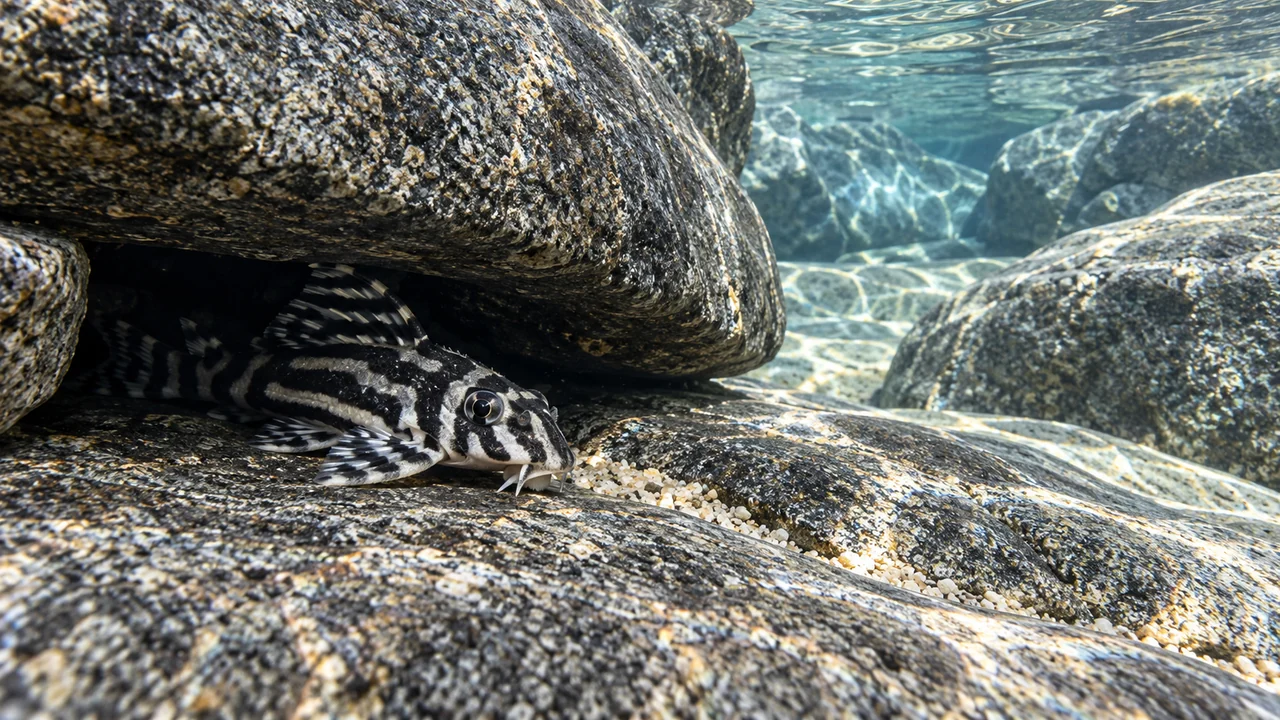
The completed Hypancistrus zebra guide is a useful starting point for one small, cave-using Xingu fish. It proposes warm stable maintenance around 27–29°C with strong oxygenation and a substantial feeding plan. Use the profile's full advice before choosing stock. Its conservation status and legal provenance matter; seek legitimate documented captive-bred animals rather than treating a rare fish as a design accessory.
Multiple shelters and territory spacing are necessary if keeping more than one, and the proposed tank dimensions do not determine a safe group automatically. Offer suitable complete sinking foods with animal ingredients and varied appropriate foods near accessible shelter entrances. Zebra plecos must not be expected to survive on algae. Do not add cold-water torrent fish or generic community fish solely because the aquarium has current.
7. Commission the system before livestock
Verify the biological cycle, temperature stability, pump guards and aeration before introducing animals. Measure pH and hardness and select stable values suitable for the chosen fish, not the brown-water chemistry used in another guide. Check that every intended refuge receives exchanged water without becoming a high-velocity trap. Use direct oxygen measurements where available, especially during warm periods or while establishing the system.
Observe the aquarium after lights-out as well as during the display period. Fish sheltering by day may feed later, so make deliberate feeding observations rather than interpreting an empty foreground as poor stocking. Check that the heater cannot be exposed during water changes and that equipment restarts correctly after routine maintenance. Do not use a simulated river flood or sudden chemistry swing as part of normal commissioning.
For suitable biological filtration, Natural Volcanic Lava Rock can be compared with Coarse Mesh Filter Media Bags as media and containment options within the chosen filter. The lava listing supplies small filter pieces, so retain separately selected stable habitat stones and caves for the channel itself.
8. Maintain oxygen and feeding access
At water changes, siphon accessible seams and remove trapped food around cave entrances. Clean mechanical media when it restricts flow, preserving established biological media appropriately. Inspect guards, aeration and pump output rather than relying on motor noise. Warm water and added organic waste make loss of effective gas exchange particularly important to address promptly. Never seal a cave because its entrance looks untidy.
Watch body condition and feeding, not only whether the fish still occupies a favourite crevice. A clear aquarium can hide underfeeding and trapped waste. Recheck rock stability after working nearby and avoid moving occupied shelters casually. If breathing changes or fish abandon refuges, check temperature, water quality, oxygenation and recent equipment changes before assuming that another stone or another botanical will solve the problem.
Keep the channel readable as it matures
If sand blows into piles, redirect the jet or adjust the seams instead of covering the problem with heavier sharp gravel. If waste collects behind an inaccessible ridge, remove a secondary stone and restore a service route. If territorial fish cannot avoid each other, change shelter spacing or the stocking plan; stronger current does not resolve social incompatibility. An extra cave is useful only if its position is usable.
The final result should feel mineral, open and alive with moving light. Low stable rocks define several quiet refuges connected to a clean main route. It is deliberately unlike the shaded leaf-floor projects: botanicals remain optional, the water need not be amber, and the ongoing success of the display rests on oxygenation, feeding and practical maintenance rather than a dense decorative forest.
Further reading and sources
Natural-history references inform the habitat discussion. Dimensions, construction sequence and maintenance access are BBA design proposals, not measurements from a documented wild site or a claim that the pictured aquarium has been stocked and tested. Choose livestock using the linked species guide.
- Barbosa et al., 2015 — middle Xingu fish assemblages — Primary field study: clear-water setting, hydrology and oxygen-related assemblage context; not aquarium target values.
- Fitzgerald et al., 2018 — Xingu rapids fish conservation — Primary research abstract on the distinct rapids fauna and dependence on flowing habitats.
- Zebra pleco — BBA species guide — Sourced species-specific maintenance, feeding and conservation guidance.