Fish · Bleher’s Rummy-Nose Tetra
Bleher’s Rummy-Nose Tetra — Petitella bleheri: Habitat and Care
A silvery, red-headed shoaling fish whose active swimming needs a longer aquarium. Identify the actual rummy-nose species, retain open water and keep maintenance steady instead of using head colour as a water test.
- Identity
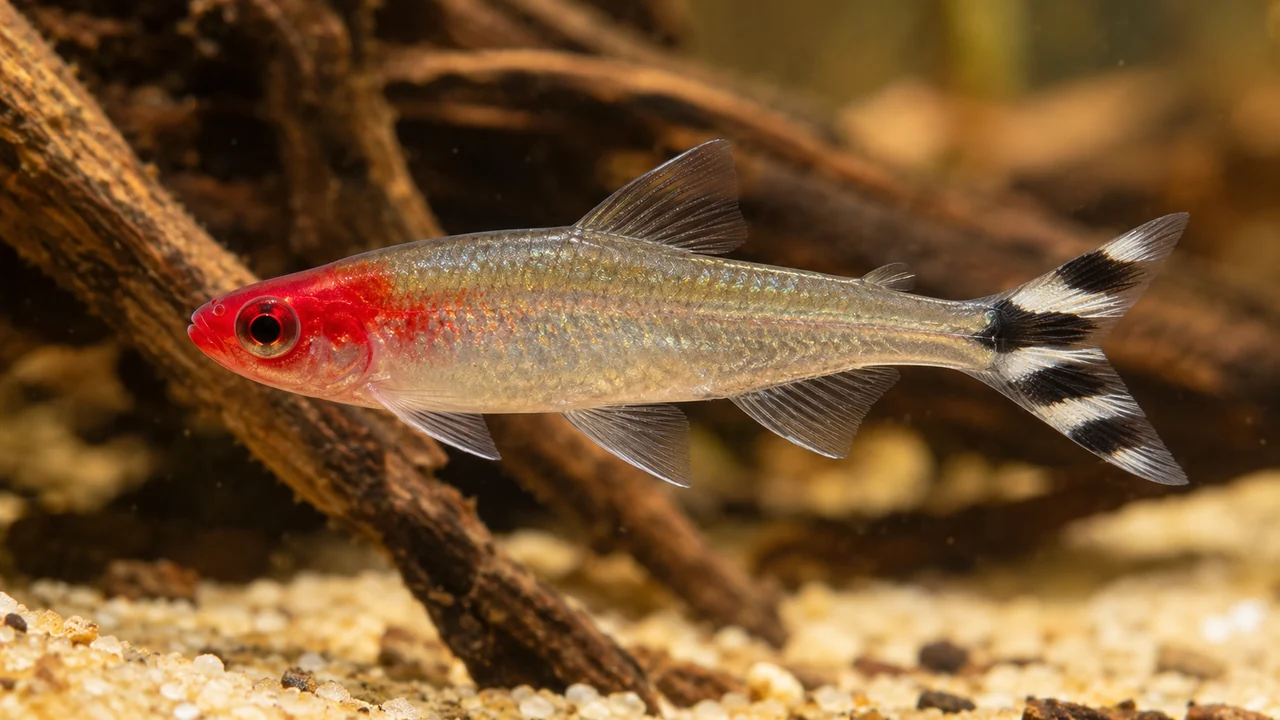
- Petitella bleheri, formerly Hemigrammus bleheri; also firehead or brilliant rummy-nose tetra. Other rummy-nose species remain distinct.
- Adult scale
- Plan around a fish roughly 5 cm long; some guides quote standard length, excluding the tail.
- Group and swimming space
- At least 10 together, preferably more when space allows. The species-specific husbandry recommendation is a tank at least 90 cm long.
- Adult water guide
- Seriously Fish: 23–26°C, pH 5.5–7.0, hardness 2–15°dGH. Prepare stable suitable water; separate warmer spawning methods from routine care.
- Diet
- Small complete foods with appropriately sized live/frozen variety; the slender fish still has a small mouth.
- Priority
- Mature filtration, oxygen, regular maintenance and an unobstructed horizontal swimming route.
Which rummy-nose tetra is it?
This profile concerns Petitella bleheri, long sold as Hemigrammus bleheri. Bittencourt and colleagues placed it and the true rummy-nose tetra in Petitella in 2020. The older name is a search alias here, not another article. Neither P. georgiae nor P. rhodostoma should silently inherit every record in this account.
A settled P. bleheri typically has red extending beyond the gill cover towards the shoulder, a silvery body and a strongly patterned black-and-white tail. The other rummy-noses differ in head-colour extent and tail/peduncle markings. Stress can fade the red, so examine the combination of characters and stated identity rather than one colour cue or the common name alone.
Native waters and what an aquarium can reproduce
The species is associated with the Negro and Meta river systems in Brazil and Colombia. Blackwater tributaries provide the natural-history context, with low-mineral water, wooded margins and seasonally changing cover. These are river systems, not one unchanging pH value or a requirement for an inaccessible pile of decomposing leaves.
A practical display can use sand and woody margins, or include suitable aquarium planting, without claiming to be an exact collection locality. Choose the water supply and maintenance plan first. Tannins may alter appearance, but brown colour cannot demonstrate that mineral content, oxygen or nitrogen waste is appropriate.
Longer space for an active adult group
Plan for at least ten of the same species and use the published 90 cm tank-length recommendation as the starting point. This is a more active, larger shoaling fish than an ember tetra. A small aquarium with enough nominal litres but little horizontal run is not an equivalent layout.
Leave the middle route open when placing wood and equipment. More fish need more usable space, filtration and food; increasing the group is not a cure for an overcrowded tank. Make sure every animal can turn, move with the group and retreat from feeding competition without being pushed into an isolated corner.
Stable adult water and working filtration
Seriously Fish recommends 23–26°C, pH 5.5–7.0 and hardness 2–15°dGH for maintenance. Its separate spawning account uses warmer conditions. Do not take a breeding temperature or a photograph of a discus community as an instruction to keep every rummy-nose group hot indefinitely.
Run a mature biological filter with reliable circulation and surface movement. Ammonia and nitrite should be undetectable. Check water quality and perform regular partial changes with conditioned, suitably matched water. Keep the filter intake clear and check actual flow after maintenance; a running motor does not prove water is moving around the whole aquarium.
Frame the swimming lane
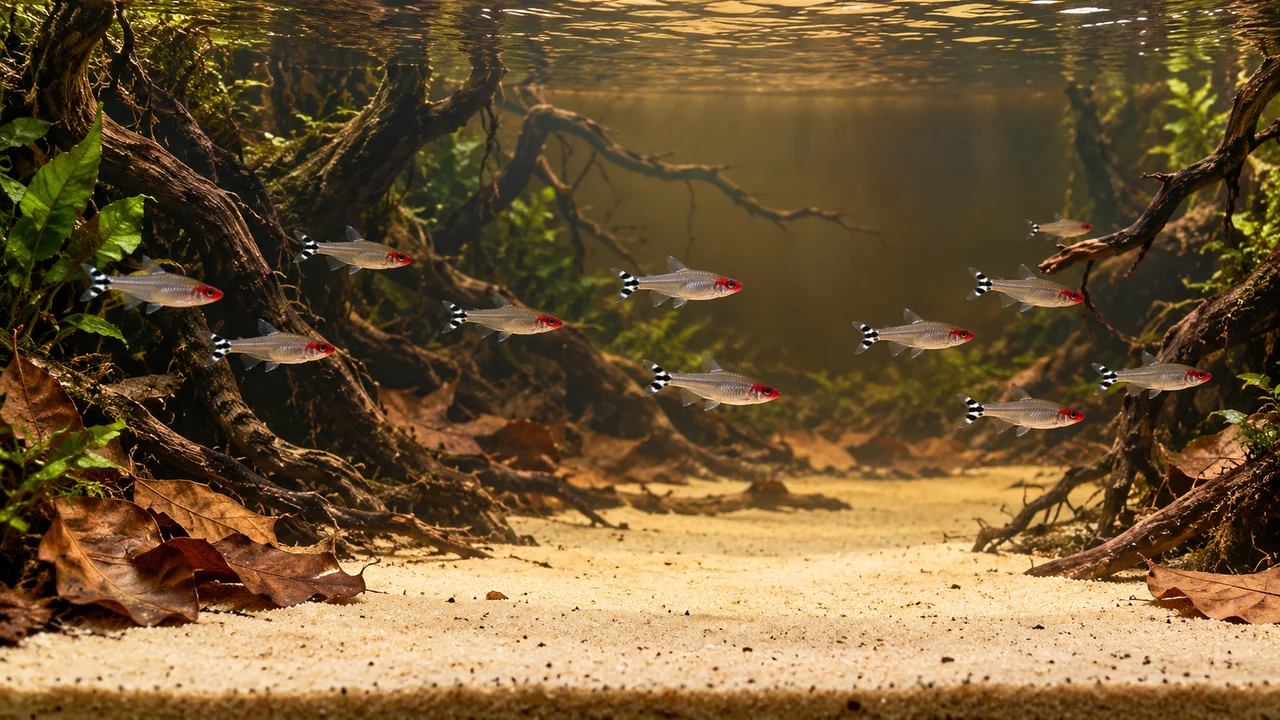
Place substantial roots towards the back or ends, keeping an open horizontal route. A thin scattered leaf margin can soften the transition to sand without covering feeding debris. Dimmer edges give the group choices, while open surface and filter access remain useful.
The pictured aquarium leaves the centre intentionally clear. It is not necessary to remove all planting, but plants should not close the only swimming route as they grow. Use the quiet-edge layout guide for ideas on vertical roots and accessible leaf pockets, then scale the arrangement to a longer active group.
Observe the group without forcing a spectacle
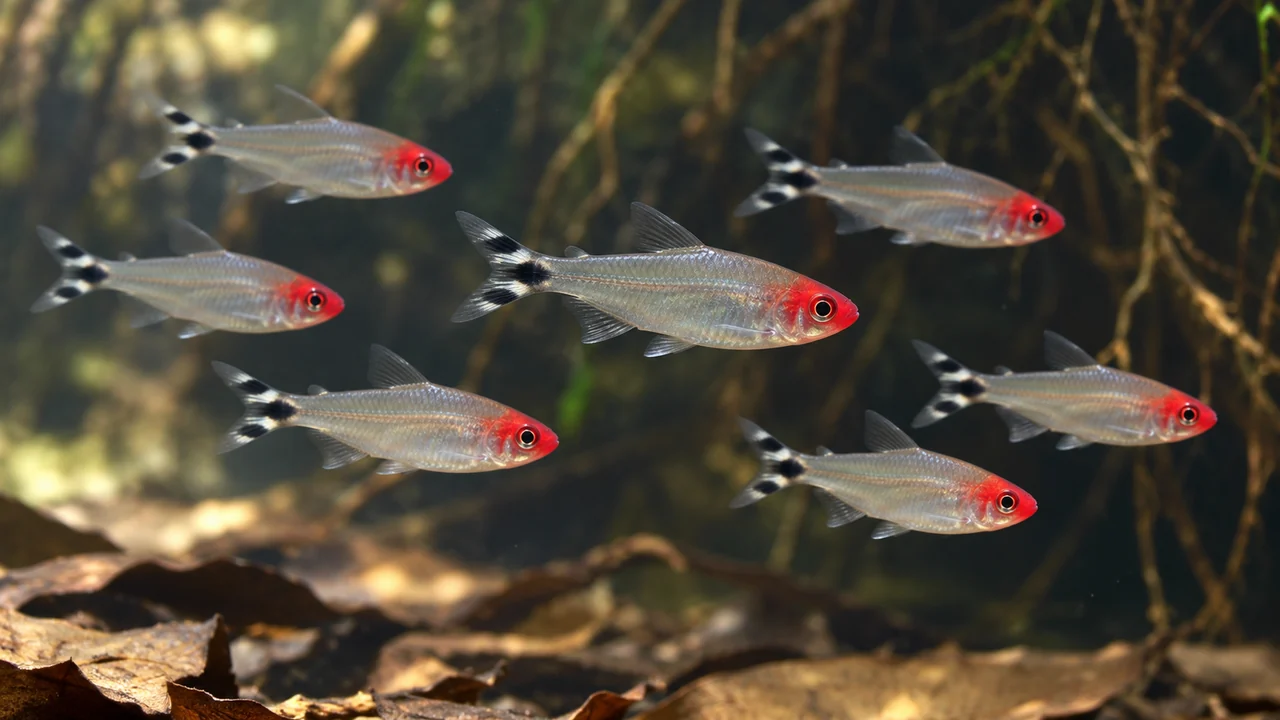
Rummy-noses often gather and travel together conspicuously. Give them room to do so, but do not use a predator or repeated disturbance to make the group school more tightly. Comfortable fish also need to feed, rest and explore rather than perform continuously.
Watch for one animal dropping behind, persistent clamped fins or unusually heavy breathing. Head colour is useful to notice, but it is not a live ammonia meter and cannot diagnose the cause of a problem. Check actual measurements and the recent history of the aquarium when behaviour changes.
Small food and calm competition
Offer balanced flakes or small granules that the fish can swallow, with appropriately sized live or frozen foods as variety. Spread a modest meal along the group’s route instead of allowing it to collect behind the wood. Observe whether slower individuals are feeding, not just whether the leaders are active.
Avoid aggressive or much larger feeders and fish with mouths large enough to take a tetra. Calm tankmates must also share the actual temperature and water plan. Eggs and tiny shrimp are potential food. A species being kept with another fish somewhere is not a guarantee for a different aquarium, adult size or breeding territory.
For supplementary invertebrate-food variety, Microalgae Freeze Dried Tubifex Worm Cubes offers a freeze-dried cube format that can be presented at the surface or against the glass. Offer only an appropriately small wetted portion the fish can swallow; this is a prepared food, not live prey or a fry starter.
Breeding requires egg protection and tiny first food
P. bleheri is an egg-scatterer without parental care. A deliberate attempt uses conditioned adults, a separate dim spawning aquarium, soft appropriately acidic water and fine plants, mops or a safe egg-protection barrier. The adults will eat eggs, so arrange removal or separation rather than expecting the shoal to protect them.
Husbandry accounts use warmer spawning conditions than their adult maintenance range, and describe light-sensitive early eggs and fry. Have minute first foods available before spawning; infusoria-type cultures are used before larger foods become usable. Keep nursery flow gentle and water clean. Do not copy a precise hatch timetable as a promise under every temperature or water supply.
The role and limits of botanicals
Wood and leaves are useful for arranging shaded margins and creating surfaces. Start with a small amount of correctly identified, prepared material. Keep it away from intakes and leave room to remove collected waste. A long swimming fish should not have to pass through a narrow pod opening to reach half the aquarium.
Read the preparation and trapping-risk guides before choosing enclosed decorations. No leaf addition guarantees a particular pH, disease prevention or spawning. If decomposition and feeding exceed the aquarium’s capacity, extra tint does not make the load safer; reduce the cause and restore the working conditions.
For the leaf-and-structure margin beside the shoal, compare Dried Bodhi Leaves (Ficus religiosa) – Aquarium Leaf Litter with Blackwater Botanical Box – Leaves, Cones, Pods & Catappa Mix. Use selected material in small stages while keeping the swimming corridor and feeding area open. A mixed box provides material to choose from over time, rather than a quantity to add all at once.
Common problems and useful first checks
For a suddenly pale or gasping group, first check oxygenation, temperature, filter flow, ammonia and nitrite. Look for a recent water change, heater fault, chemical exposure or missed maintenance. Use suitable conditioned water and aeration to address an identified problem rather than adding medicine because the red has faded.
For repeated losses or persistent abnormal swimming, quarantine and aquatic-health assessment may be needed. Review source and arrival condition as well as the display tank. Avoid chasing head colour with additives, and do not introduce more fish into unresolved losses. Preserve a record of measurements and changes so any advice can address the actual sequence.
Further reading and sources
Natural-history research and taxonomic records are distinguished from aquarium recommendations. Care ranges below are husbandry guidance, not survival limits; breeding conditions are discussed separately. Botanical materials do not replace appropriate water, food or maintenance.
- Bittencourt et al. (2020): Paracheirodon relationships and Petitella revision — Primary molecular and morphological work: separate neon species, native-drainage context and the transfer of bleheri into Petitella. Not an aquarium care trial.
- FishBase: Petitella bleheri — Species-specific accepted combination and referenced biological/distribution record; not a source of images for this page.
- Seriously Fish: Petitella bleheri — Species-specific husbandry synthesis for size, group/space, adult water guidance and reproductive context; recommendations, not controlled survival thresholds.