Fish · Blackwing Hatchetfish
Blackwing Hatchetfish — Carnegiella marthae: Habitat and Care
A smaller, subtly marked hatchetfish for a calm, carefully covered aquarium. Protect its upper-water feeding space and identify it separately from marbled hatchets and the spotted-bellied Carnegiella schereri.
- Identity and size
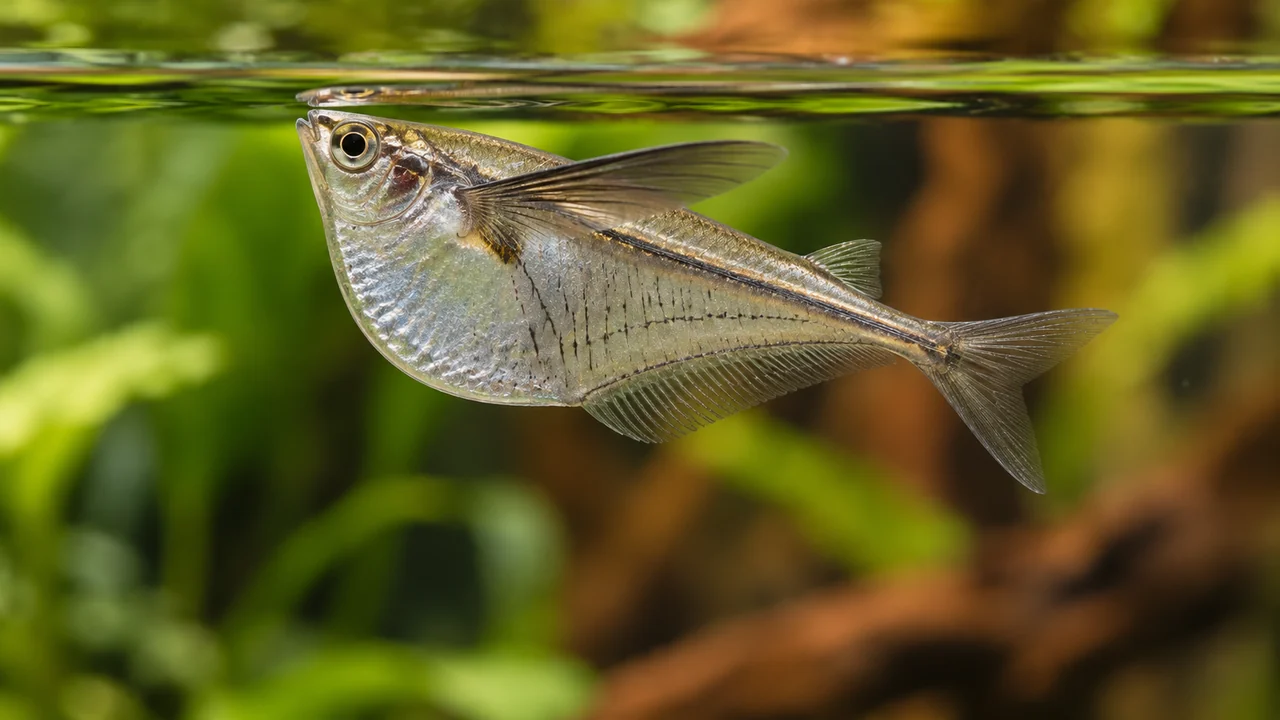
- Carnegiella marthae; about 2.8 cm standard length, roughly 3 cm overall in importer accounts. Fine-lined belly and dark pectoral fins; no adipose fin.
- Space and group
- Ten or more; published starting surface footprint 60 × 30 cm. Allow extra area for companions, not just greater depth.
- Surface safety
- Secure lid with small equipment gaps closed; floating shelter beside open feeding patches and adequate air space.
- Water and temperature
- Published 20–28°C, pH 4.0–7.0 and 1–10°dGH. Prefer stable soft acidic conditions, with 24–26°C a central maintenance choice.
- Feeding
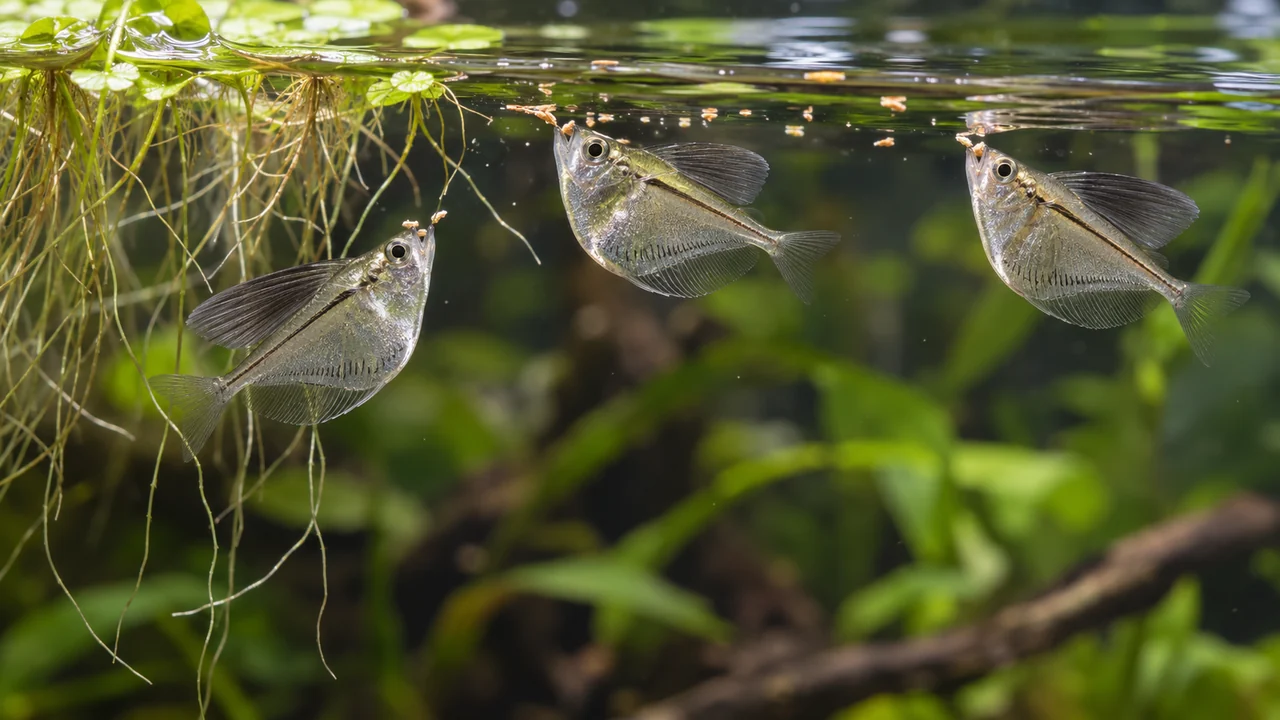
- Tiny accessible foods at the surface; verify every individual eats before food sinks or is taken by companions.
- Breeding
- The principal specialist husbandry reference records captive reproduction as unrecorded; no dependable routine method is claimed here.
A blackwing is not a small marbled hatchet
Carnegiella marthae has the deep hatchet-shaped outline but a subtler silver body than C. strigata. Look for the dark pectoral area and fine lower-body linework rather than bold diagonal marbling. Aquarium Glaser also distinguishes it from C. schereri, whose belly is spotted. Small mixed imports deserve a careful check rather than identification from a bag label alone.
The name Carnegiella marthae is retained here. Older marthae marthae wording can be useful when searching, but schereri is not treated as an alias for this article. Large silver Gasteropelecus are also different fish; the lack of an adipose fin helps distinguish Carnegiella. Size, markings and shape need to be considered together, not reduced to the phrase “black-winged hatchet”.
Blackwater association with limits to the map
Published accounts associate blackwings with the upper Orinoco and Negro systems, with shaded flooded margins and forest streams important to the habitat picture. Research discussed in the sources suggests more complex population boundaries than a simple wide-range label implies. Keep any actual collection information rather than assigning a locality from appearance.
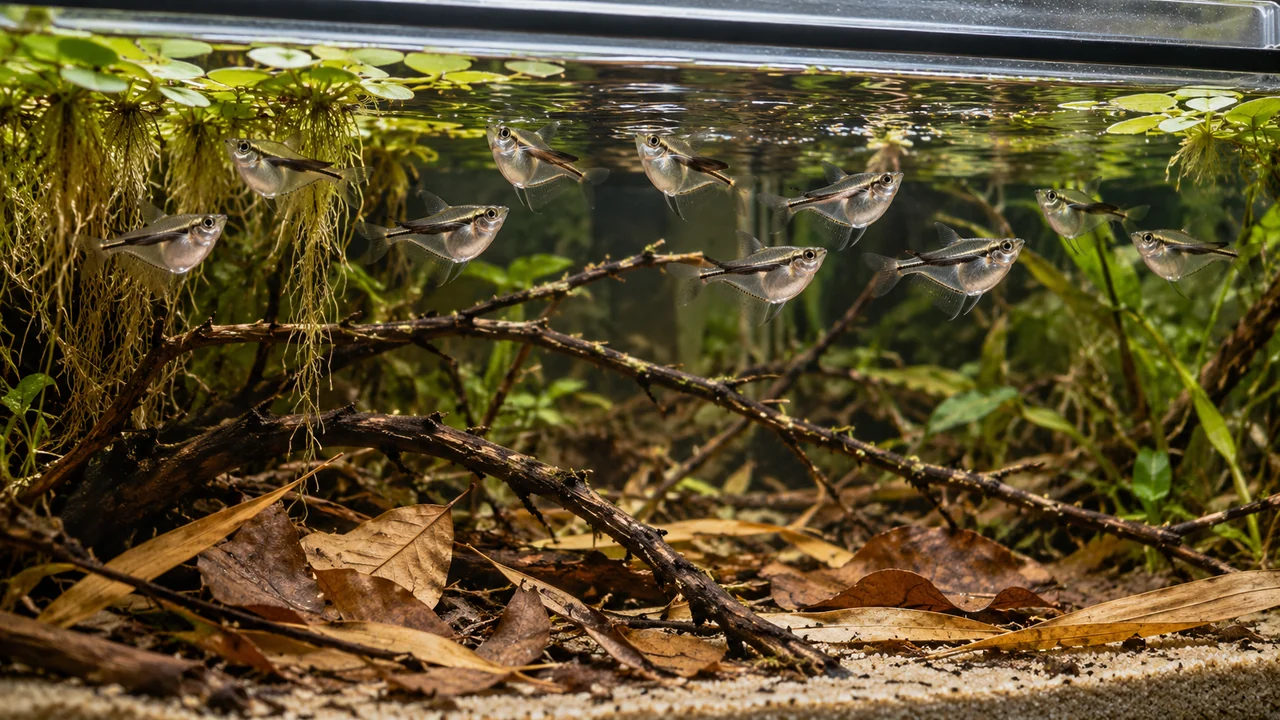
For practical keeping, recreate calm covered edges and accessible surface water in a mature aquarium. A dark tint is only one visual feature. It does not prove low mineral content or adequate oxygen. The supporting arrangement is an aquarium example, not a documentary record of a wild site. That distinction allows useful planting and maintainable litter without pretending to copy a natural forest exactly.
Small fish, shared surface
Keep a group of around ten or more with at least the published 60 × 30 cm surface footprint. More room is valuable if other fish occupy the upper water. The smaller size compared with a marbled hatchet should not be used to squeeze both species into a surface designed for only one group.
Give the blackwings several sheltered resting patches connected by open water. Observe the least visible fish at meals and keep a clear view from the side. A group may hover quietly rather than constantly swim together. Check for exclusion or food competition before deciding that inactivity is a health problem. Extra depth contributes water volume, but cannot create a second waterline for competing occupants.
The whole cover matters
Fit the lid before stocking, including safe coverage of openings around pipes and cables. Check feeding doors and corner gaps, not only the large central panel. Floating vegetation reduces exposure but cannot contain a startled fish. Leave air space above the water and maintain gas exchange; a lid is an escape barrier, not an instruction to make the aquarium airtight.
Keep maintenance calm and openings attended. A small net movement can cause an unexpected jump even in an otherwise settled group. Recheck the fit after cleaning or moving equipment, and close the feeding hatch as part of the routine. Do not rely on being able to catch an escaping fish or on a different species’ apparently lower jumping tendency.
Consistent soft water and gentle circulation
The published adult-care range is 20–28°C, pH 4.0–7.0 and 1–10°dGH. For a planned display, a steady 24–26°C with soft acidic water is a useful central approach. These broad figures are recommendations, not survival limits or a reason to swing between endpoints during maintenance.
Use an established biological filter, conditioned replacement water and an independently checked thermometer. Keep the return away from the only feeding patch while retaining visible surface movement elsewhere. Monitor ammonia and nitrite when fish are added or behave differently. Floating roots can shelter fish, but dense growth also needs thinning and inspection for trapped food. Gentle circulation must still reach the aquarium rather than leaving stagnant pockets.
Feed the smallest mouths first
Food should arrive in small accessible particles near the surface. A suitable complete fine food can be varied with small live or frozen invertebrates; do not assume that any flake or whole frozen organism fits this fish’s mouth. Observe actual swallowing and ask what recently imported stock has already accepted.
Deliver small portions in more than one quiet location. If fish approach but fail to take food, compare size and sinking speed. If they remain behind cover while companions finish the meal, solve access rather than simply adding more. A lower-water clean-up crew can conceal leftovers without preventing hunger above it. Record body condition and appetite over time, particularly during initial establishment.
Neighbours should leave the upper layer usable
Choose small calm neighbours with overlapping water requirements. Fast surface feeders, aggressive residents and adult mouths capable of swallowing a blackwing are unsuitable. Even a non-predatory species can dominate the small feeding windows between floating plants.
Plan the actual positions occupied by each group and allow more surface area when adding competitors. Hatchetfish are not automatically safe because another species stays near the floor most of the day; breeding or feeding can change that pattern. Keep a removal option available for a failed combination. No companion should be added solely to frighten the group into a more photographic formation or to make another animal feel secure at its expense.
Breeding: acknowledge what is not documented
Seriously Fish lists captive reproduction as unrecorded for C. marthae. This guide therefore does not claim a dependable home breeding method or transfer the disputed marbled-hatchetfish account to blackwings. A rounder individual is not sufficient evidence of sex, a compatible pair or imminent spawning.
An advanced breeding project would need verified identity, detailed observations and a separate mature rearing plan, including suitable microscopic food. Preserve locality records and do not confuse survival of newly imported adults with a successful closed breeding cycle. The practical recommendation for ordinary keeping is to maintain the group well, rather than destabilise water chemistry in pursuit of an unverified schedule or guaranteed outcome.
A manageable botanical arrangement
Fine roots can carry shade towards the waterline while a modest floor of prepared leaves and small pods provides texture below. Keep open feeding patches, safe passages and access for maintenance. A heavy dark floor cannot solve an exposed top or a direct jet that sweeps food away.
If fish lose condition, watch meals before changing chemistry. For breathing changes, test water and check temperature, filter flow and oxygenation promptly. Review recent introductions and seek suitable fish-health advice for persistent illness. Add botanicals gradually and inspect decomposing material; they do not cure disease or prove that waste is controlled. Check the cover after every adjustment to plants, hoses or lighting.
For the quieter lower margin beneath the occupied upper water, compare Dried Jackfruit Leaves (Artocarpus heterophyllus) – Blackwater Leaf Litter with Crushed Catappa Leaves – Indian Almond Leaf Pieces. Use selected pieces around the planted edge while retaining the open surface-feeding lanes and secure cover described above.
Further reading and sources
Identity and natural-history sources are distinguished from aquarium husbandry. Recommended care is not a set of experimentally established survival limits; breeding conditions may differ from adult maintenance.
- Seriously Fish — Carnegiella marthae — Species-specific husbandry, adult scale, social arrangements and reproduction. Read explanatory water notes, not just summary numbers.
- Harvard MCZbase — Carnegiella marthae — Institutional identity record; not an aquarium-care prescription.
- Aquarium Glaser — Black winged dwarf hatchets — Direct importer distinction between marthae and spotted-bellied schereri.
- Amazonian ornamental-fish ethnoknowledge study — Primary regional study includes marthae; regional fishers’ seasonal knowledge is not a controlled captive breeding protocol.