Fish · Marbled Hatchetfish
Marbled Hatchetfish — Carnegiella strigata: Habitat and Care
A striking surface fish whose deep silver keel carries dark marbling. A secure cover, usable surface area and food that stays within reach are central to care, not optional accessories to the aquascape.
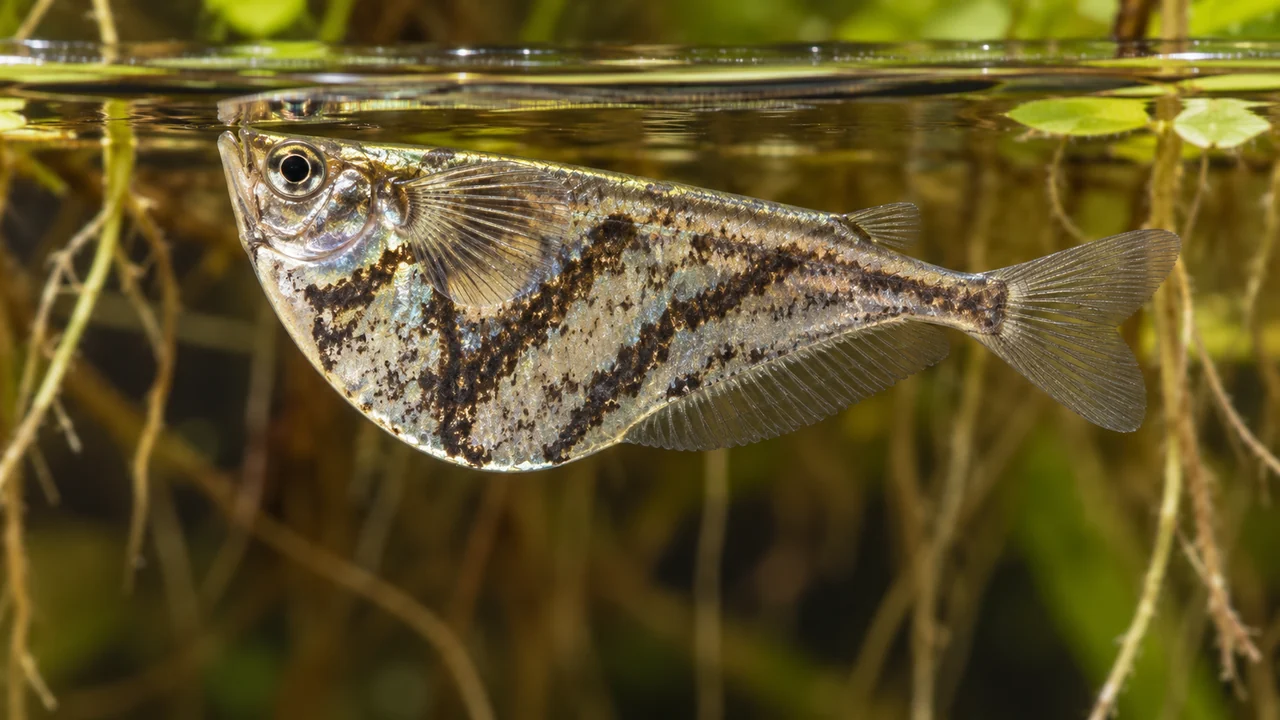
- Identification
- Carnegiella strigata; around 3.5–4 cm in published accounts. Deep hatchet-shaped belly with conspicuous diagonal marbling; no adipose fin.
- Space and group
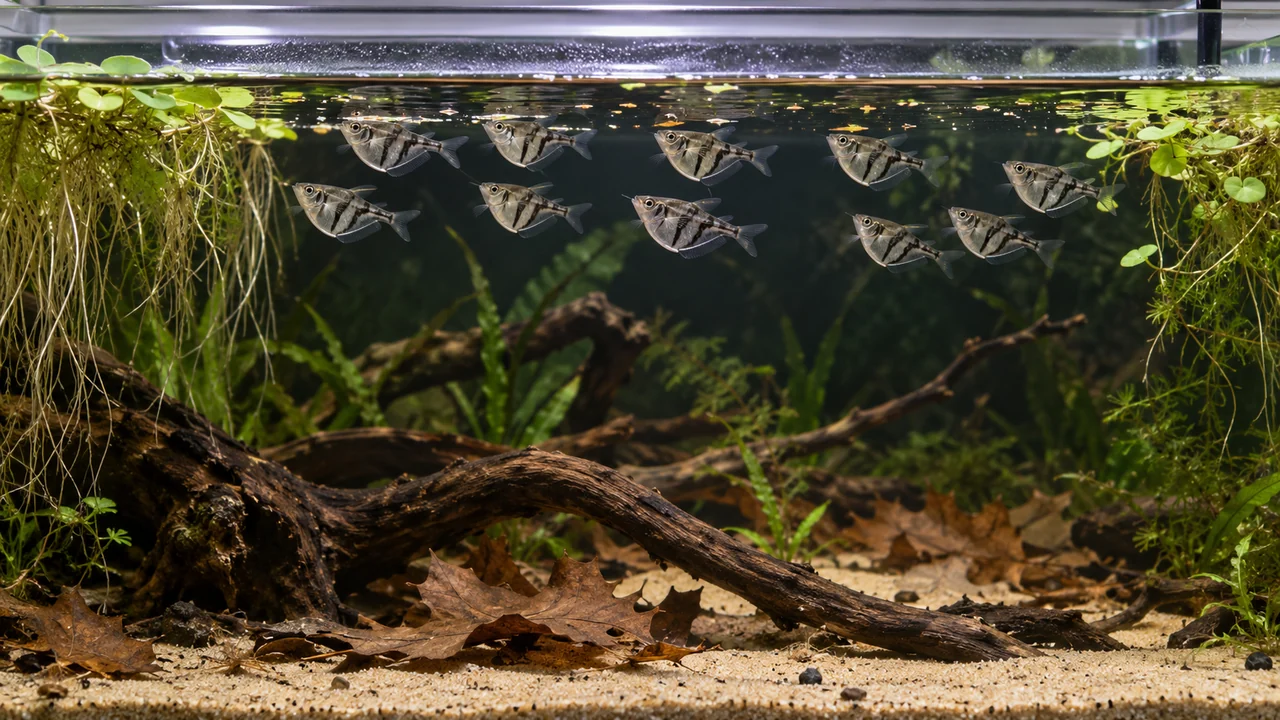
- Plan ten or more with a surface footprint around 75 × 30 cm or larger; additional surface occupants require more room.
- Cover and surface
- Tightly fitted lid with cable and pipe gaps secured. Open feeding water beside floating cover, with air space above it.
- Water
- Published 20–28°C, pH 4.0–7.0, 1–10°dGH. A stable 24–26°C and soft acidic conditions are a practical starting preference.
- Feeding
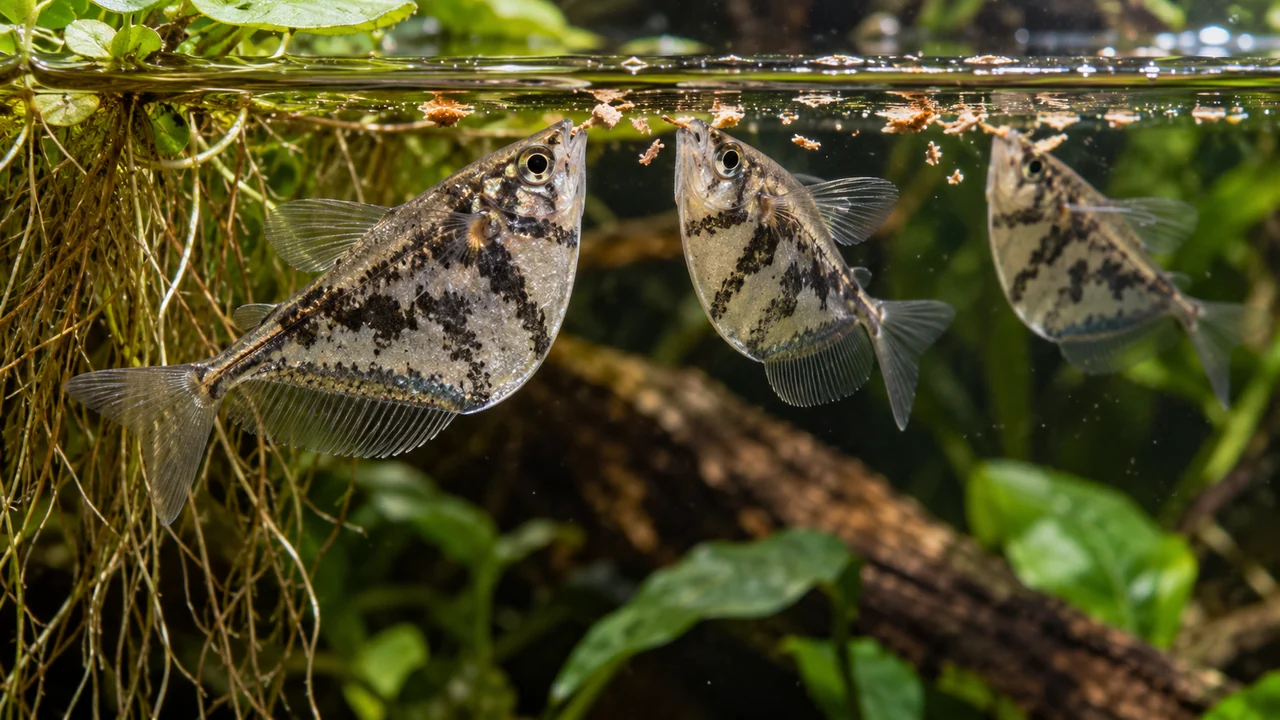
- Small floating or very slowly sinking complete foods and varied suitable invertebrates; watch every fish at the surface.
- Reproduction evidence
- Accounts disagree: TFH reports captive success; Seriously Fish lists it as unrecorded. No guaranteed breeding method is inferred.
Identify the marbled hatchet
The very deep keel, near-level back and surface-oriented mouth make a freshwater hatchetfish easy to recognise as a group. For Carnegiella strigata, look for the strong irregular dark diagonal marbling across the silver belly. Do not substitute a mostly plain blackwing or a larger Gasteropelecus merely because it occupies the same layer.
The older name Gasteropelecus strigatus and historical strigata form names are retained as search aids. Aquarium Glaser notes that “vesca” is also used in trade in a way that should not be mistaken for proof of collection locality. Keep a supplier’s actual provenance separately from the visual pattern. The new portrait is a representative subject, not a claim to show a documented population or sex.
Forest margins and a variable range
Published records place the species broadly in Amazonian and Orinoco waters and parts of the Guianas, with blackwater-associated margins an important habitat context. The specialist literature also questions whether all populations assigned to this name represent one uniform unit. A broad distribution map should not be turned into a claim that every imported batch is interchangeable.
In the aquarium, the relevant structure is near the surface: overhanging cover, open feeding patches and calm routes between them. A spectacular floor of leaves does little if the top is exposed, turbulent or inaccessible. Design from the waterline down, then add a maintainable bottom arrangement. That produces a useful habitat-inspired display without pretending to reproduce an entire floodplain.
Group space and conflicting advice
A useful group plan is ten or more with at least around a 75 × 30 cm surface footprint, following the specialist species recommendation. Other published guidance ranges from six upwards, while one TFH author recommends solitary keeping in cramped circumstances. These are not equivalent instructions. This guide favours a properly spaced group rather than using inadequate space to justify isolation.
Watch actual access and interactions. Every fish should be able to rest beside cover and take food without being driven against a corner. Increase surface room or reconsider companions if the available strip is crowded. A tall tank adds water volume, but does not give the hatchetfish another surface. Keep a calm group rather than trying to create tightly coordinated movement through disturbance.
Fit the lid before obtaining fish
Use a secure cover and check openings around filter pipes, cables, feeding flaps and corners. Small gaps are still escape routes. Floating plants are useful shelter, not a replacement for a lid. Leave suitable air space between water and cover and preserve ventilation rather than trying to solve jumping by sealing an aquarium airtight.
Plan feeding and maintenance so the opening is small and attended. Replace the lid immediately afterwards. Avoid sudden chasing with a net or abrupt movements above the water; a calmer routine reduces startling but cannot guarantee that a fish will never jump. If a canopy needs an open gap for equipment, correct the gap safely before adding hatchetfish rather than treating repeated escapes as an unavoidable trait.
Water, oxygen and a calm surface
The species account gives 20–28°C, pH 4.0–7.0 and 1–10°dGH. Stable 24–26°C with soft acidic water is a reasonable practical starting preference, subject to the actual stock’s history. Those endpoints are not daily targets. Establish the aquarium and prepare replacement water consistently before introduction.
Use biological filtration and distribute the return so that oxygen exchange continues without driving the whole group away from its feeding area. Gentle does not mean stagnant. Check ammonia and nitrite when behaviour changes and retain a regular partial-change routine. Protect a quiet surface lane from a direct filter jet, and keep floating cover from spreading into an unbroken mat. Check the actual temperature beneath a warm canopy too.
Deliver food where it can be eaten
Offer small complete flakes or suitable floating particles, with varied fine live or frozen invertebrates. Clean cultured small insects can be useful where they are an appropriate mouthful; avoid collecting potentially contaminated insects around the home or garden. Observe the food at the surface instead of assuming a general tropical feeding routine reaches these fish.
Many portions fall away before a cautious fish takes them. Feed modestly at several accessible points and watch each individual swallow. If most food sinks, change delivery or food type before increasing the amount. Keep track of body condition from side and oblique views. Bottom residents eating the leftovers do not prove the hatchetfish were fed, and an abundant leaf bed does not provide a complete adult menu.
For supplementary invertebrate-food variety, Microalgae Freeze Dried Tubifex Worm Cubes offers a freeze-dried cube format that can be presented at the surface or against the glass. Offer only an appropriately small wetted portion the fish can swallow; this is a prepared food, not live prey or a fry starter.
Companions and surface competition
Choose quiet fish of suitable adult size that leave the top usable. Rowdy feeders can create a problem without biting. Beckford’s pencilfish, for example, merits particular caution as a competing upper-water resident in smaller layouts. A broad label such as “peaceful” does not describe feeding speed or how much of the surface a group occupies.
Avoid predators and persistent fin nippers. Consider what happens during another species’ breeding period as well as an ordinary meal. Hatchetfish should not be treated as expendable dither animals for an aggressive cichlid. Where several groups are proposed, draw the usable surface and feeding positions first; adding more nominal litres below cannot solve a crowded top.
What can be said about breeding?
The available husbandry sources disagree. Tropical Fish Hobbyist states that breeding has been accomplished, with soft acidic water, conditioned adults and tiny first foods. Seriously Fish records reproduction as unrecorded. That supports describing captive breeding as reported but poorly documented here, rather than calling it impossible or offering a tested BBA recipe.
If pursuing specialist breeding, establish identity and locate a detailed credible account before changing conditions. Prepare a separate mature rearing system and appropriately tiny foods, and record observations. Do not transfer the timings or egg-care behaviour of a tetra or Apistogramma to a hatchetfish. Routine adult care should remain stable while the evidence for any experimental breeding plan is assessed.
Botanicals and useful first checks
Modest prepared leaves and roots can shade and structure the aquarium, but keep feeding and surface access primary. Leave floor areas that can be inspected and cleaned. Organic additions should be gradual, with attention to water quality and oxygenation rather than an ambition to make the water as dark as possible.
For thin fish, check what they actually eat. For persistent crowding at one end, examine the return current, exposed lighting and competitors. For rapid breathing, check oxygen, temperature and ammonia/nitrite promptly. Quarantine new arrivals where practical and seek appropriate help for disease signs; do not interpret every health problem as an insufficient tannin level. Check the cover again after every equipment alteration.
For the quieter lower margin beneath the occupied upper water, compare Dried Magnolia Leaves – Natural Aquarium Leaf Litter with Blackwater Botanical Box – Leaves, Cones, Pods & Catappa Mix. Use selected pieces around the planted edge while retaining the open surface-feeding lanes and secure cover described above. A mixed box provides material to choose from over time, rather than a quantity to add all at once.
Further reading and sources
Identity and natural-history sources are distinguished from aquarium husbandry. Recommended care is not a set of experimentally established survival limits; breeding conditions may differ from adult maintenance.
- Seriously Fish — Carnegiella strigata — Species-specific husbandry, adult scale, social arrangements and reproduction. Read explanatory water notes, not just summary numbers.
- Tropical Fish Hobbyist — Marbled Hatchetfish — Husbandry and a reported captive breeding success; conflicts with the unrecorded status in the other account.
- TFH — surface-dweller discussion — Author observations include different group advice. This guide does not adopt solitary keeping as a substitute for sufficient surface area or speculative flight claims.
- Aquarium Glaser — Carnegiella accounts — Direct importer descriptions of pattern variation and trade names; no photographs reused.