Fish · Black Neon Tetra
Black Neon Tetra — Hyphessobrycon herbertaxelrodi: Habitat and Care
A bright pale stripe above a dark band gives this active shoaling fish its understated appeal. Plan a planted aquarium with a real swimming lane, rather than treating it as a differently coloured neon tetra.
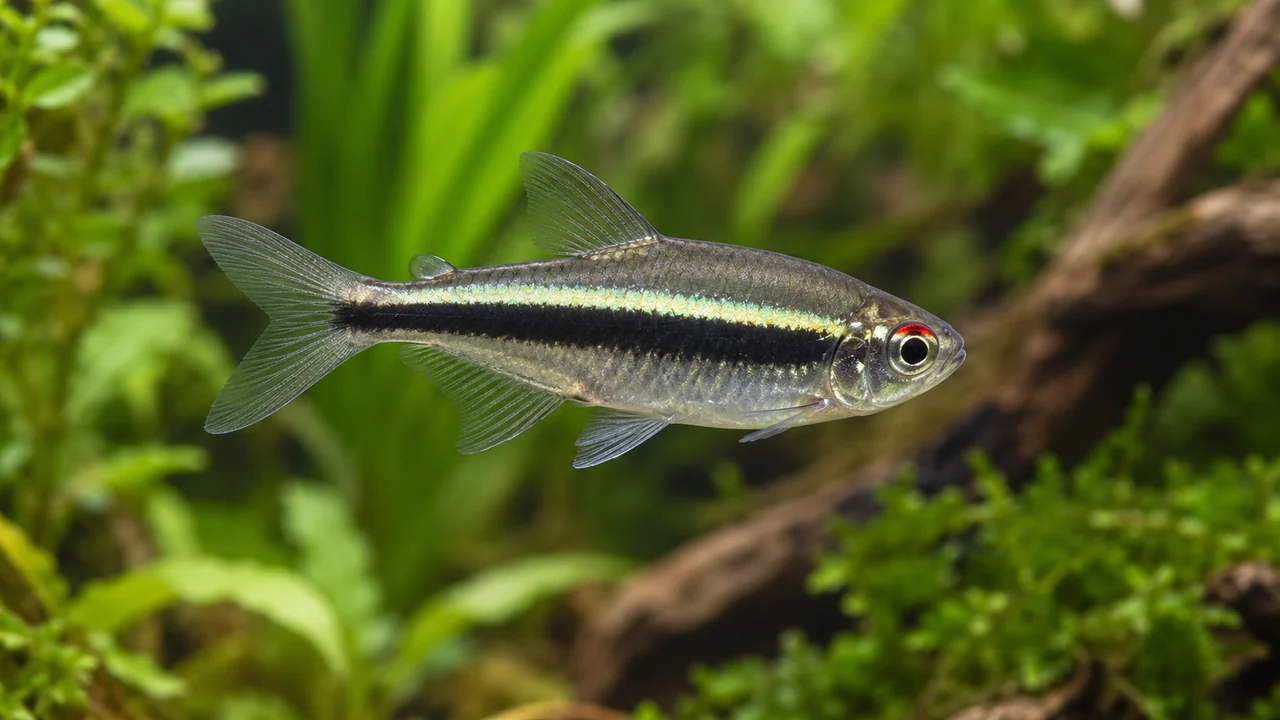
- Identity and size
- Hyphessobrycon herbertaxelrodi; about 3.5 cm standard length, around 4 cm including the tail.
- Social space
- Aim for 8–10 or more. An 80 × 30 cm base is the published starting footprint; allow more room for a community.
- Practical temperature
- Published care range 20–28°C; a stable 23–25°C is a sensible central maintenance choice.
- Water
- Published pH 5.0–7.5 and 1–12°dGH. Choose stable conditions within the range; do not pursue its endpoints.
- Feeding
- Small complete foods plus suitably sized live/frozen invertebrates; observe every fish feeding.
- Breeding
- Freshwater egg scatterer; adults do not raise the young. Protect eggs and prepare microscopic first foods.
Recognising a black neon
The narrow reflective line above the broad black side band is the useful first clue. Look also for the reddish upper eye and mainly transparent fins. This is not a Paracheirodon neon with a missing red stripe: the body is fuller and the pattern belongs to a different fish. A confident identification should use shape and markings together, particularly when shop lighting changes the apparent colour.
Hyphessobrycon herbertaxelrodi remains the name used here. The familiar label “black neon” is a common name, not a subspecies of the cardinal or neon tetra. An adult should have a comfortably filled abdomen and move level through the water. Treat persistent wasting, clamped fins or isolation as a reason to investigate, rather than explaining everything through its naturally quiet colouring.
Range and the habitat lesson
Its native setting is the upper Paraguay drainage of Brazil, including the Pantanal region. That is a different geographical story from simply calling every striped tetra an Amazon blackwater fish. The US Fish and Wildlife Service account and the habitat references below distinguish native distribution from records of introductions elsewhere.
For aquarium planning, the useful lesson is a mixture of cover and swimming water. A planted layout is entirely appropriate; dense leaf litter is optional. Do not remove healthy plants to make the aquarium look more “authentic”, or darken the water until the fish disappear. A habitat-inspired aquarium should still let you see the group, assess feeding and reach the substrate during maintenance.
A group needs length, not a tall vase
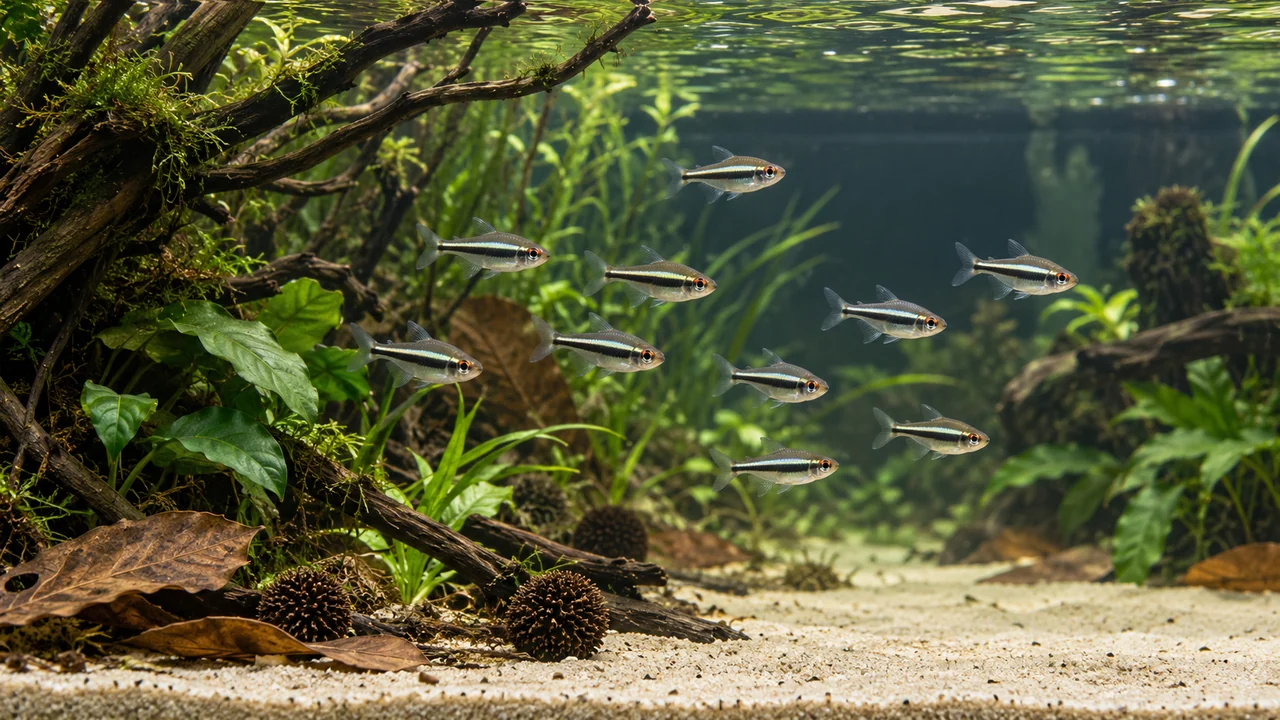
Use the 80 × 30 cm starting footprint as a planning reference rather than a stocking formula. Keep a group of 8–10 or more and increase the usable space when adding other midwater fish. The fact that an individual is only around four centimetres long does not mean a narrow desktop container gives the whole group adequate movement.
Arrange the main route across the front or centre, with planting behind and at the ends. Check the view from the fish’s level: a large root placed across the only gap can divide an apparently spacious aquarium into two cramped pockets. Leave more than one way around major pieces so a timid fish cannot be cornered during feeding or brief social chasing.
Water, oxygen and a repeatable routine
Seriously Fish gives 20–28°C, pH 5.0–7.5 and 1–12°dGH for maintenance. A steady 23–25°C offers a useful central starting point for ordinary aquarium keeping, subject to the stock’s established conditions and compatible companions. These figures are not permission to move between the extremes during water changes. Measure the replacement water as well as the aquarium.
Use an established biological filter and retain visible surface movement. Ammonia and nitrite should be undetectable with the tests you use. Set a regular partial-water-change routine, then adjust it from waste trends, feeding and stocking rather than water colour alone. Do not clean all filter media and replace the entire leaf bed in the same session. That makes it harder to understand the cause if the aquarium becomes unstable.
Planting, branches and a modest leaf layer
Fine stems or taller background plants can frame the swimming lane without filling it. Low branchwork provides shade and a visual break; keep sharp tips away from narrow passages. A few broad leaves or small pods on the floor can make the lower area interesting while leaving open sand for inspection and cleaning.
Prepare botanicals before adding them, check that they are suitable for aquatic use and introduce small amounts at a time. The aim is structure and a manageable decomposing material load. Leaves are not a substitute for a filter, and brown water is not proof of ideal chemistry. Remove material if it traps excessive food or makes an area impossible to siphon, rather than following a rigid replacement calendar.
For the leaf-and-structure margin beside the shoal, compare Premium Mangrove Leaves – Natural Aquarium Leaf Litter with Blackwater Botanical Box – Cones, Leaves, Pods & Texture Mix. Use selected material in small stages while keeping the swimming corridor and feeding area open. A mixed box provides material to choose from over time, rather than a quantity to add all at once.
Feeding the whole shoal
Offer a small complete flake or micro-granule that each fish can actually swallow. Vary this with appropriately sized frozen or live invertebrates such as small Daphnia or Artemia. Food should be distributed along the group’s feeding area, not deposited in one pile behind the strongest fish.
Watch a normal meal from the side. A fish that darts towards food but repeatedly spits it out may need smaller particles. One that never reaches the food may be losing out to tankmates. Reduce the portion if food settles unused; increasing it to compensate for competition usually leaves more waste without solving access. Aquarium biofilm and loose detritus do not remove the need for a balanced feeding routine.
For supplementary invertebrate-food variety, Microalgae Freeze Dried Tubifex Worm Cubes offers a freeze-dried cube format that can be presented at the surface or against the glass. Offer only an appropriately small wetted portion the fish can swallow; this is a prepared food, not live prey or a fry starter.
Companions and everyday behaviour
Choose peaceful fish with overlapping temperature and water needs, manageable adult size and a feeding style that does not overwhelm the tetras. The “community fish” label is a starting point, not a guarantee for every combination. A predator large enough to swallow a black neon is unsuitable even if the water figures happen to match.
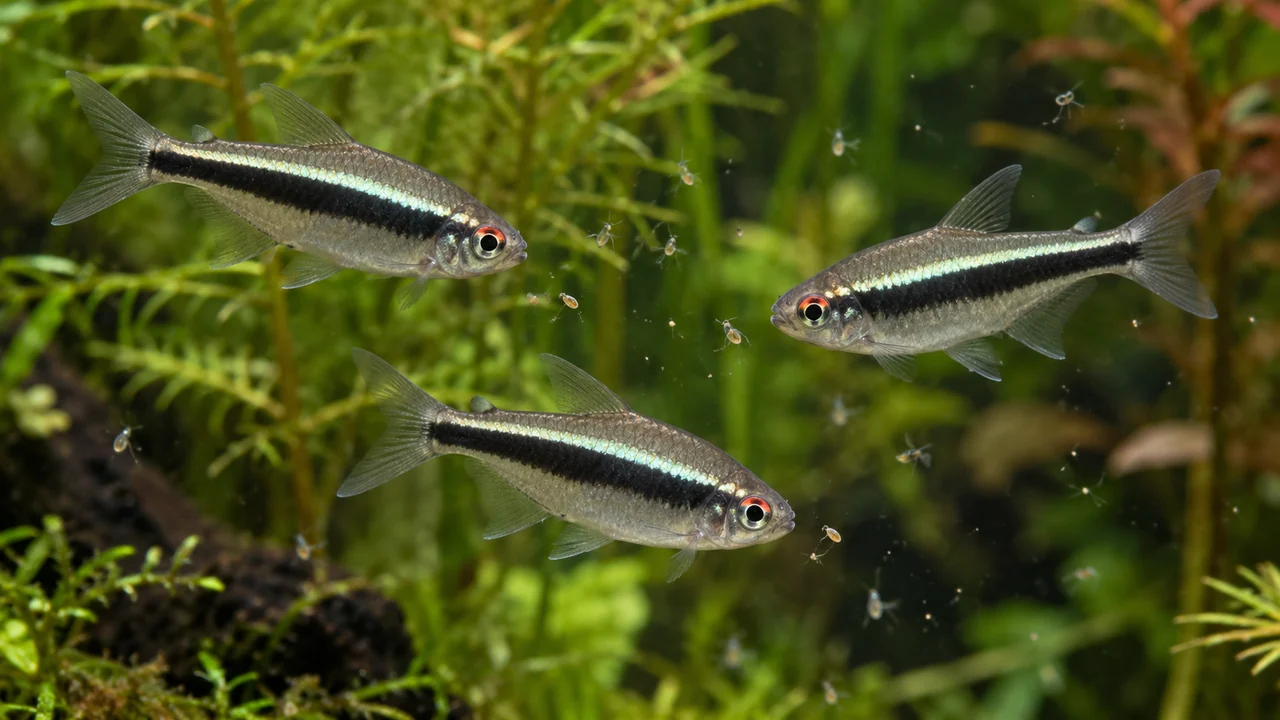
A relaxed group may spread out rather than swimming in a perfectly synchronised formation. Constant tight schooling is not a husbandry target by itself. Check for disturbance, exposed lighting or intimidating companions if the group never ventures out. Tiny shrimp offspring can be eaten; an attractive planted display should not be advertised as a guaranteed shrimplet nursery simply because the adult fish are peaceful.
Breeding is a separate project
Black neons scatter eggs in freshwater and provide no parental care. The Tropical Fish Hobbyist account describes conditioning adults, using plants or mops in a separate spawning setup and removing adults afterwards. A mixed display may occasionally produce a survivor, but it is not a reliable way to protect eggs.
Prepare the rearing environment and a microscopic first-food supply before trying to collect fry. Use a mature gentle filter that cannot draw them in. Breeding water and the feeding needs of tiny larvae deserve separate attention from the adult maintenance range. Do not acidify the main community or increase the heater simply because a breeding account uses different conditions.
If something looks wrong
For pale or hidden fish, first check water tests, temperature, surface movement and recent changes, then examine the social situation. A newly introduced group may need quiet cover; persistent rapid breathing is not something to dismiss as acclimatisation. Check whether all fish or only one individual are affected.
If fish lose condition despite food being offered, verify what each actually swallows and review quarantine and disease possibilities with suitable help. Do not add extra leaves as a general cure. A written record of water readings, food, additions and symptoms is more useful than repeatedly changing several things at once. Keep spare conditioned water and a practical way to isolate a sick fish available.
Further reading and sources
Species-specific husbandry references inform the care summary. Taxonomic and field sources answer different questions from aquarium recommendations; none establishes a treatment effect for a BBA product.
- Seriously Fish — Hyphessobrycon herbertaxelrodi — Species husbandry: adult size, group, footprint, water conditions and reproduction; distinguish the stated range from a daily target.
- US Fish and Wildlife Service — ecological risk summary — Institutional species identity and native/introduced distribution context.
- Tropical Fish Hobbyist — Black Neon Tetra — Adult total length, identifying appearance and practical feeding/breeding account.