Fish · Tucano Tetra
Tucano Tetra — Tucanoichthys tucano: Habitat and Care
A miniature blackwater specialist whose tiny size makes feeding, water preparation and companion choice more demanding, not less. Plan a mature species-focused aquarium with fine foods and shaded structure.
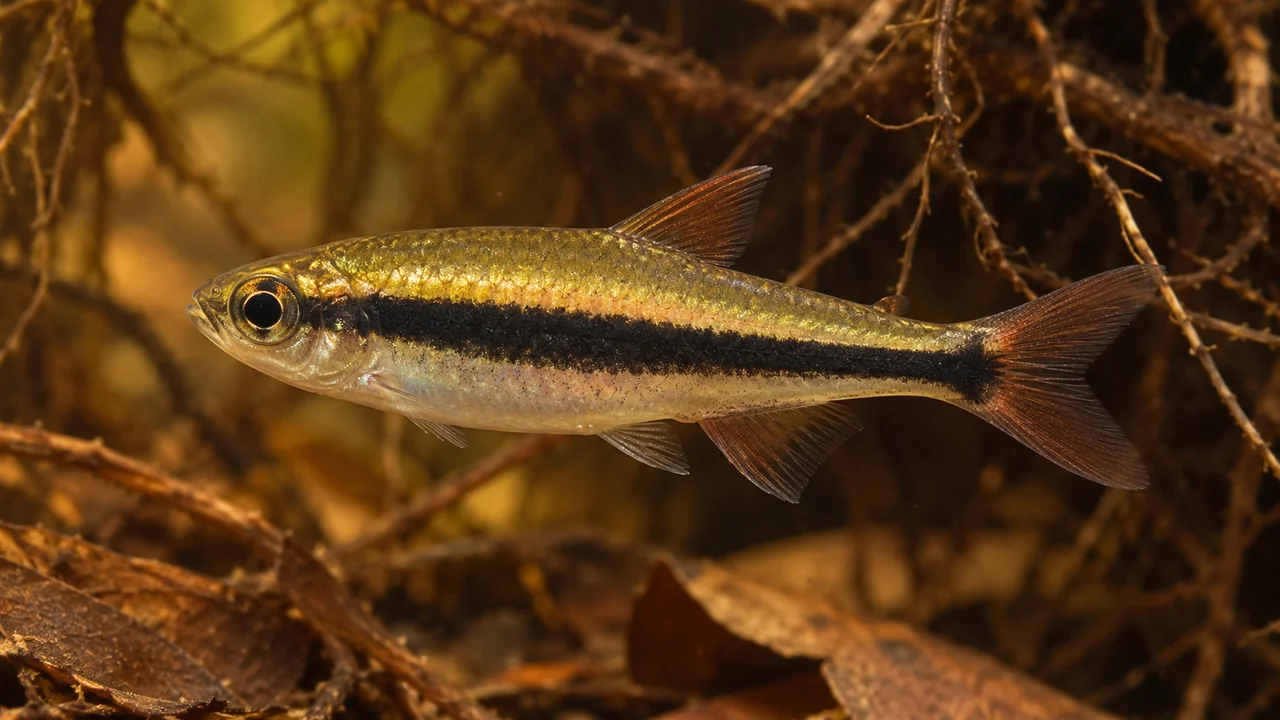
- Identity and adult scale
- Tucanoichthys tucano; about 1.7 cm standard length. A miniature adult, not a juvenile larger tetra.
- Social space
- 8–10 or more; published starting footprint 45 × 30 cm. Larger well-structured space offers more stability and retreat routes.
- Temperature
- Published 20–28°C; a stable 24–26°C is a practical central choice, consistent with reported collection conditions.
- Water
- Published pH 4.0–6.5, 1–8°dGH. Prioritise a controlled soft acidic system; extremes are not beginner targets.
- Feeding
- Tiny mouthfuls; observe intake. Supply appropriately small complete food and small live/frozen prey.
- Breeding distinction
- Males defend a spawning surface and attend eggs; do not apply a generic no-parental-care tetra template.
A genuinely miniature fish
Tucanoichthys tucano remains the name used for this small species. Its pale golden translucent body and conspicuous dark side stripe form a useful visual starting point; adult males can show red in the fins. The blue-green appearance reported for early young is not the adult portrait standard. A fish around two centimetres including its tail can already be mature.
Size alone is not sufficient identification. Ask for the scientific name and provenance, especially with mixed imports or a label such as “tiny blackwater tetra”. The primary description and later osteological work address the species rather than treating it as a small version of a familiar neon. Keep it separate from other miniature fishes in both stocking decisions and breeding records.
What the field record does and does not tell us
The original description concerns the Uaupés system in Brazil’s upper Negro basin. Its collection account describes a forest creek with branchwork and accumulated leaves, strongly stained water and very low mineral content. A single collection’s chemistry is evidence about that place and time, not a universal aquarium prescription.
The useful translation is a mature soft-water setup with shade, shelter and reliable oxygenation. Do not attempt a deep wild-style debris bed in a small aquarium simply because a field account records one. Aquarium dimensions, feeding inputs and gas exchange differ. It is more honest to build a controlled habitat-inspired arrangement than to claim that matching a water colour recreates the creek’s ecology.
Is it suitable for this aquarium?
This is a specialist choice where the keeper can prepare consistent soft water and supply tiny foods. It is not an automatic recommendation for a beginner’s mixed community or a newly filled nano tank. Resolve those practical requirements before obtaining fish rather than hoping a bag of leaves will convert unsuitable tap water.
The published starting base is 45 × 30 cm for a group of 8–10 or more. More space provides scope for retreats and a larger water volume, but does not eliminate the need for established filtration. Think about access too: can you see each fish eat, clean the feeding area and isolate an unwell individual without dismantling the display? A small species can be difficult to monitor in an oversized tangle.
Prepare water rather than chase a reading
Published husbandry spans 20–28°C, pH 4.0–6.5 and 1–8°dGH. A stable 24–26°C is a practical central temperature choice. For this species, soft acidic water is a real planning requirement, not decorative wording. The lowest pH figure should not be treated as a target for a newly assembled system.
Where tap water is unsuitable, prepare replacement water from a controlled source such as correctly managed RO water with appropriate mineral adjustment. Measure GH, KH and, where useful, conductivity; these are not interchangeable scales. Very low buffering makes careless changes harder to recover from. Do not pour acid directly into a stocked aquarium to reproduce a field number. Establish a repeatable preparation routine and introduce fish only after that routine is reliable.
Maturity, oxygen and clean feeding space
An established filter and stable organic load matter more than the age written on a calendar. Check ammonia and nitrite, confirm actual flow and retain surface movement. Use a protected intake so tiny fish cannot be drawn in. A gentle local flow around the fish should coexist with adequate circulation and gas exchange across the aquarium.
Build shade with branchwork and selected planting or floating cover, leaving a visible feeding lane. The illustrated aquarium is an arrangement option, not a documentary photograph of the plant-free type locality. Maintain access beneath the branches and avoid a sealed floating mat. A small unnoticed food deposit matters more when many tiny meals are used, so keep a narrow siphon and a clear inspection area available.
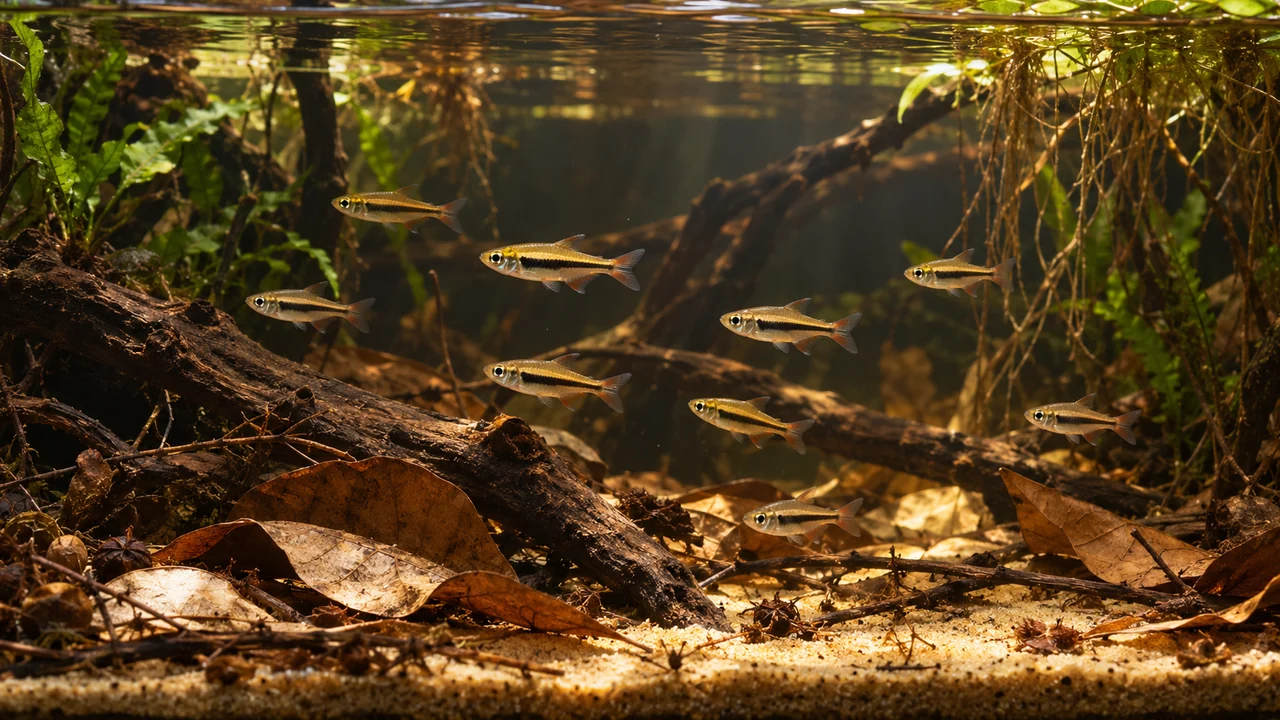
The practical challenge is food size
Do not assume that a micro-pellet is small enough merely because of its label. Observe whether the fish takes and swallows it. Provide suitably fine complete food where accepted, and varied tiny live or frozen prey. Newly hatched Artemia or small water fleas can be useful at the appropriate size; large frozen pieces are not equivalent.
Use small measured portions and watch quiet individuals, rather than letting the boldest fish confirm that “the group has eaten”. Establish the accepted menu with the supplier before purchase and keep a workable live-food supply if needed. Microbial growth around leaves may supplement the environment, but cannot be treated as a complete diet. A mature-looking aquarium can still contain fish that are slowly losing condition.
Companions and territorial males
A species-focused display makes feeding and observation easier. Other inhabitants must be genuinely diminutive, non-predatory, calm and suited to the same water. The fact that a larger fish occurs in the same drainage is not a recommendation to share a small aquarium. Even apparently peaceful companions can monopolise food or swallow a miniature tetra.
Males establish small territories, particularly around breeding surfaces. Provide visual boundaries and several routes through the layout rather than a single defended doorway. Watch for one individual consistently excluded from food or cover. The group is social without being a permanently synchronised school; do not add a disturbing tankmate just to make it tighten formation for photographs.
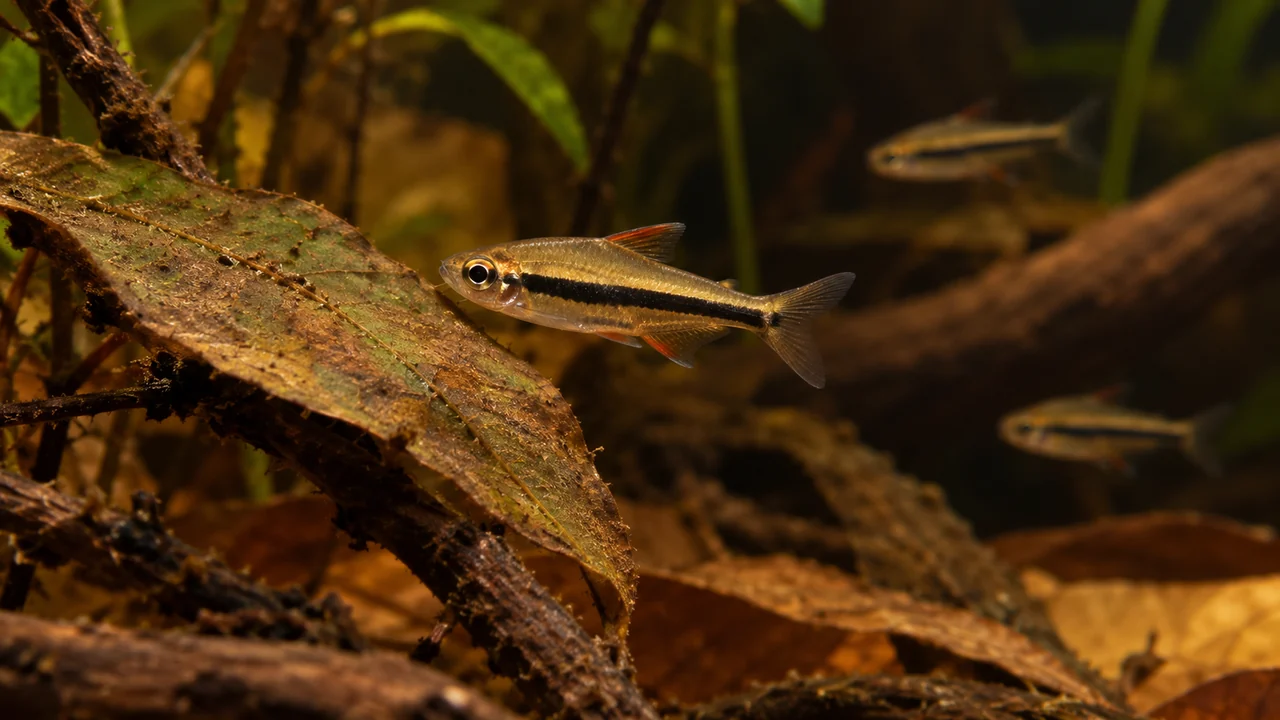
Breeding is not generic tetra egg scattering
Accounts describe males holding temporary territories around a leaf or piece of wood and remaining with the eggs. This is an important difference from the no-parental-care pattern of many familiar aquarium tetras. A mature structured aquarium may produce some young, but intentional rearing still requires close observation and a plan for exceptionally small fry.
Provide appropriate soft acidic breeding conditions and established fine-food cultures before attempting a rearing project. Avoid disturbing an attended site merely to count eggs. Protect young from intake hazards and unsuitable companions. Do not prescribe a guaranteed hatch time or yield, and do not automatically remove the male because a different tetra guide says to remove all adults. Follow the observed reproductive behaviour of the actual species.
Botanicals are structure, not a shortcut
A small amount of prepared leaf litter and suitable wood gives shaded surfaces and physical complexity. Choose pieces that leave visible water between them. Different leaves and modest pods can be used without building a thick inaccessible layer; inspect openings and decay as part of normal maintenance.
Tannins do not prove that the mineral content is appropriate, and they do not guarantee spawning or protect against disease. Assess the aquarium’s organic load when adding materials or increasing feeding. A cloudy bloom after a large addition is not something to ignore because the species is associated with blackwater. Keep emergency aeration and prepared replacement water available, rather than relying on colour as reassurance.
For the leaf-and-structure margin beside the shoal, compare Dried Longan Leaves – Natural Aquarium Leaf Litter with Crushed Catappa Leaves – Indian Almond Leaf Pieces. Use selected material in small stages while keeping the swimming corridor and feeding area open.
Warning signs and the first response
If fish become thinner, start with observed intake and competition. If the group breathes faster, check temperature, aeration, filter function and water tests promptly. If behaviour changes after a water change, compare the replacement-water preparation and mineral readings rather than adding another botanical.
Persistent losses, lesions or refusal to eat deserve appropriate fish-health advice. Keep records of supplier conditions, gradual acclimatisation, food and water changes so a problem can be traced. Do not make several chemistry changes at once. The specialist assessment is practical: this species is manageable for a prepared keeper, but its small size leaves less room for unnoticed feeding and maintenance mistakes.
Further reading and sources
Species-specific husbandry references inform the care summary. Taxonomic and field sources answer different questions from aquarium recommendations; none establishes a treatment effect for a BBA product.
- Seriously Fish — Tucanoichthys tucano — Species husbandry: adult size, group, footprint, water conditions and reproduction; distinguish the stated range from a daily target.
- Géry & Römer (1997) — original description — Primary species description, collection setting and reproductive observations; field measurements are not copied as universal maintenance requirements.
- Aquarium Glaser — Tucanoichthys tucano — First-hand importer account: small adult scale, soft acidic keeping and male fin coloration.
- FishBase — Tucanoichthys species entry — Institutional current identity and adult standard-length entry.