Fish · Glowlight Tetra
Glowlight Tetra — Hemigrammus erythrozonus: Habitat and Care
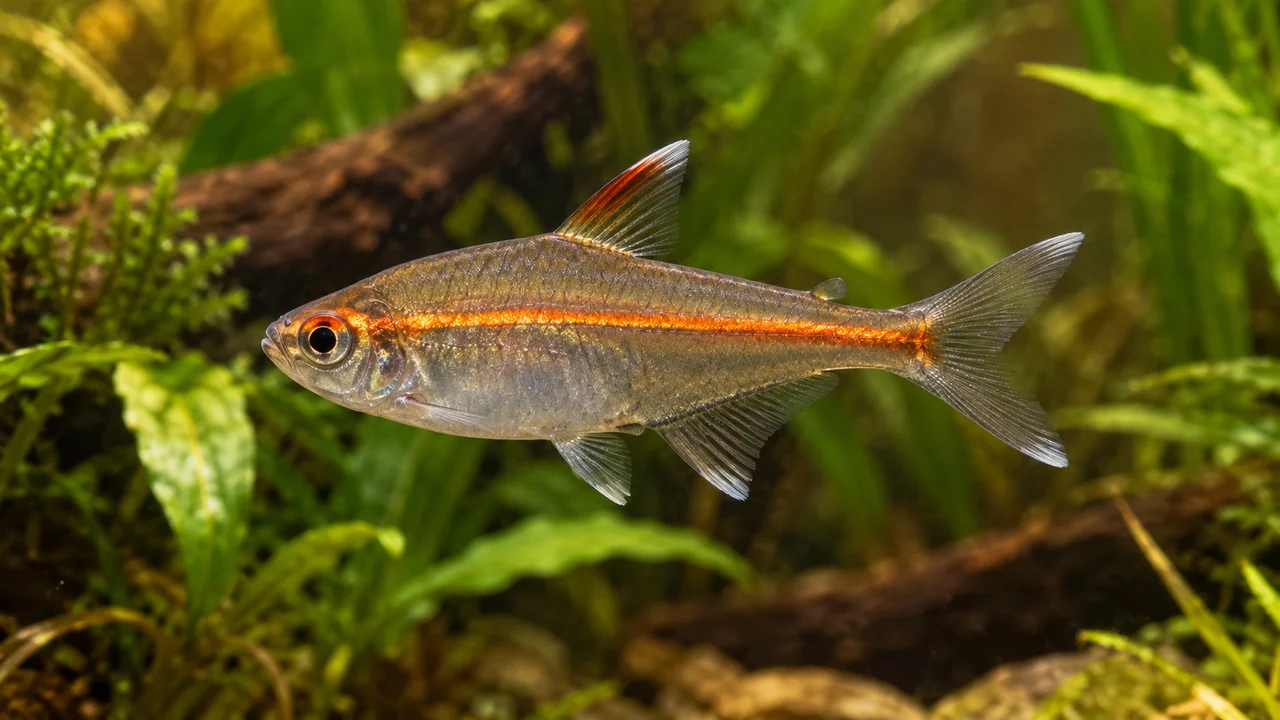
A fine copper-red line glows through a translucent body. This is the Guyanan tetra, not the similarly named rasbora; give the group warm stable water, shaded edges and room to feed.
- Identity and size
- Hemigrammus erythrozonus; around 4 cm standard length. Not the glowlight rasbora, Trigonostigma hengeli.
- Group and space
- Prefer 10 or more. Published small-group example 60 × 38 cm; more length is useful in a community.
- Temperature
- Published maintenance 24–28°C; a steady 25–26°C is a practical central target.
- Water
- Published pH 5.5–7.5 and 2–15°dGH; keep replacement water consistent.
- Food
- Small complete foods and varied small live/frozen invertebrates; check every fish can feed.
- Reproduction
- Freshwater egg scatterer; protect eggs and early fry, with subdued light and tiny foods.
A stripe rather than a rasbora wedge
The glowlight tetra has a narrow orange-red line along a largely translucent body. Its fin shape and small adipose fin help confirm the identification. The glowlight rasbora, Trigonostigma hengeli, has a different dark wedge pattern and is not an alternative scientific name for this fish.
Hemigrammus erythrozonus is retained here, with spelling variants used for search rather than extra pages. Albino ornamental stock may not show the familiar contrast strongly. Assess the whole animal and supplier identification instead of relying on one colour. Intact fins, level movement and a comfortably filled abdomen are better purchase checks than resemblance to a heavily saturated photograph.
The Essequibo connection
The species is associated with the Essequibo system in Guyana and forested tributaries. That gives a specific geographical context for shade and roots, rather than a generic assumption that every tetra comes from one Amazon creek. Distribution references answer a different question from captive husbandry recommendations.
An aquarium can use planting, sand, wood and a little litter to borrow those structural features. It need not copy extreme field chemistry for established captive-bred fish. Healthy aquatic plants can remain part of the design even where a natural account stresses forest canopy. Describe it as an aquarium arrangement, and make the fish’s needs and practical maintenance more important than a claim of geographical perfection.
A connected midwater route
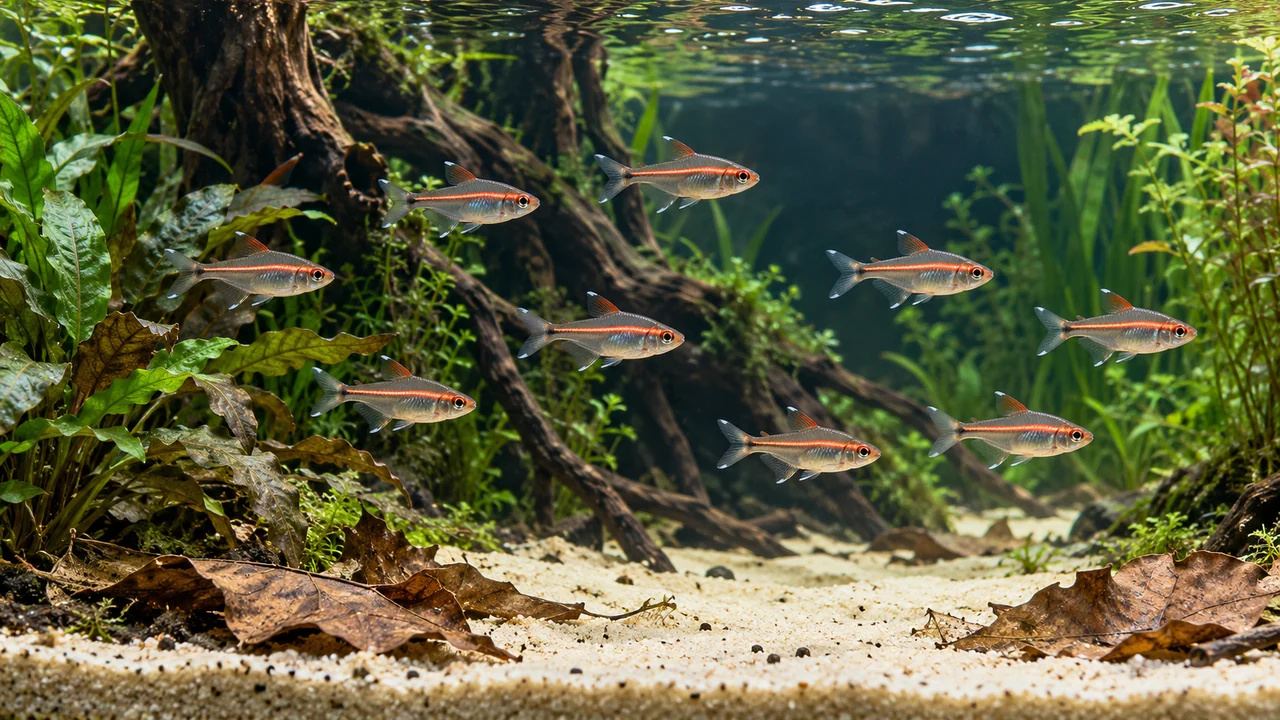
Plan a shoal of around ten or more. The published 60 × 38 cm small-group footprint is a starting example, not permission to fill the same aquarium with several other shoals. A longer layout gives more room for passing and more flexibility when companions are added.
Keep the main swimming route connected. Tall stems behind and low wood at the sides frame it without a wall of branches across the middle. Provide a quiet shaded end as well as open feeding water. You should be able to count the fish and assess condition; permanently concealing half the group behind hardscape makes routine care unnecessarily difficult.
Warm water with stable maintenance
Published maintenance guidance is 24–28°C, pH 5.5–7.5 and 2–15°dGH. A steady 25–26°C is a useful central choice for many suitable displays. These recommendations are not experimental survival limits, and matching pH does not make water with very different mineral content interchangeable.
Use a mature filter, conditioned replacement water and a separate thermometer. Retain visible surface movement and keep floating cover from closing the entire top. Test ammonia and nitrite if appetite or breathing changes. Base partial changes on stocking, feeding and water readings, with replacement water prepared consistently. Do not make last-minute chemistry corrections directly around the fish to imitate a number from a breeding account.
Shade, roots and an accessible floor
Subdued patches allow the copper stripe to show naturally. Shade part of the surface while providing enough light for the plants you keep. Fine branchwork adds depth, but leave room around it and access to the filter intake. A visible open lane also lets you observe feeding without disturbing the aquarium.
Prepared leaves and a few varied small pods can texture the floor. Keep them away from persistent food traps. They become microbial surfaces and release dissolved compounds, but are not disease treatments or precise pH controllers. Add material gradually and assess the load through oxygenation, maintenance and stock. The darkness of a photograph is not a useful dose guide.
For the leaf-and-structure margin beside the shoal, compare Dried Terminalia catappa Leaves – Aquarium Leaf Litter with TanninBae Beginner Variety Pack – 50-Piece Botanical Starter Mix. Use selected material in small stages while keeping the swimming corridor and feeding area open. A mixed box provides material to choose from over time, rather than a quantity to add all at once.
Feeding as a practical check
Offer small complete foods and vary the menu with suitably sized live or frozen invertebrates. Break up oversized pieces rather than expecting a small fish to swallow anything sold for tropical aquaria. Spread a modest portion along the group’s normal route.
Watch the slower individuals. Approaching and spitting food is different from swallowing it; never approaching may indicate intimidation or illness. Increasing the portion does not automatically solve either. Remove persistent leftovers and adjust the next meal. Leaf-litter organisms contribute to aquarium ecology, but cannot be counted as a measured balanced ration for the adult shoal. Body condition over time is more useful than an apparently busy feeding scene.
For supplementary invertebrate-food variety, Microalgae Freeze Dried Tubifex Worm Cubes offers a freeze-dried cube format that can be presented at the surface or against the glass. Offer only an appropriately small wetted portion the fish can swallow; this is a prepared food, not live prey or a fry starter.
A peaceful community still needs planning
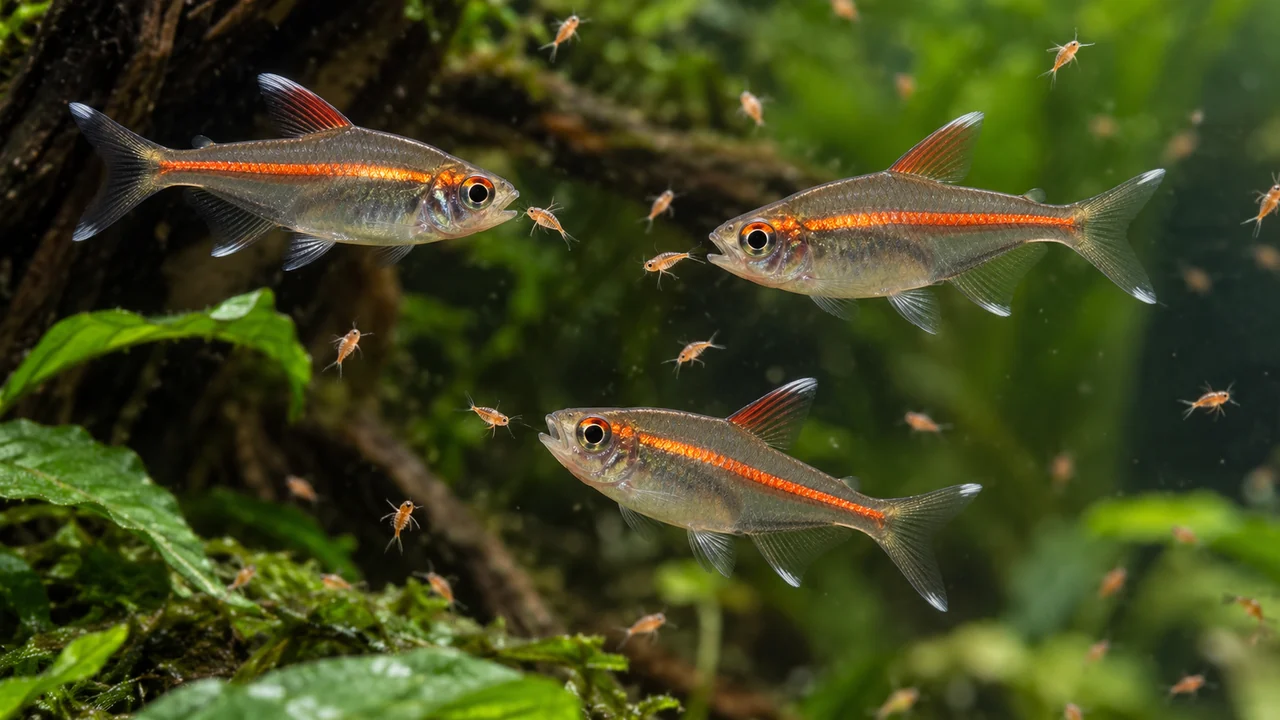
Choose companions by adult size, temperature, temperament and feeding speed. Quiet fish of similar scale may fit where their needs overlap. Avoid predators large enough to swallow a glowlight and boisterous fish that repeatedly drive the shoal into cover. Juvenile size at purchase is not the relevant long-term test.
Eggs and tiny shrimp can still become food. Do not promise a productive shrimp colony because adult tetras appear calm. Ensure bottom-dwelling companions can receive their own portions without overfeeding the whole display. If one group controls every feeding position, reassess the arrangement or stock rather than using “community suitable” as a reason to ignore the behaviour actually observed.
A separate plan for eggs and fry
Glowlights scatter eggs in freshwater without parental care. A separate mature setup with fine plants or an egg-protection arrangement is more controllable than a community. Specialist accounts use softer acidic spawning water and subdued light; that is not a requirement to change the whole adult aquarium abruptly.
Protect eggs from adults and keep early stages away from harsh lighting. Have microscopic first foods available before they are needed, progressing to larger foods when the fry can take them. Use a gently running mature sponge filter and careful small water changes. Do not promise a brood size or hatching deadline: temperature, stock and actual conditions affect the outcome.
When the glow seems to disappear
Poor colour after transport is not a diagnosis by itself. Persistent fading with clamped fins or fast breathing needs investigation: check water readings, temperature, oxygenation and companions before reaching for a treatment. Observe under ordinary lighting rather than altering the aquarium solely to make the stripe brighter.
For wasting or losses, review quarantine, actual feeding and recent additions, and obtain suitable fish-health help where necessary. Record whether one fish or the whole group is affected. Tannins do not remove ammonia or make an immature filter safe. Keeping care separate from styling makes it easier to recognise a genuine health problem without interpreting every change as a shortage of botanicals.
Further reading and sources
Species-specific husbandry references inform the care summary. Taxonomic and field sources answer different questions from aquarium recommendations; none establishes a treatment effect for a BBA product.
- Seriously Fish — Hemigrammus erythrozonus — Species husbandry: adult size, group, footprint, water conditions and reproduction; distinguish the stated range from a daily target.
- FishBase — Glowlight Tetra — Institutional identity and distribution reference.
- ETYFish — American tetra names — Scientific-name history and erythrozonus identity; no images reused.