Botanical Aquascaping · The Blackwater Tributary Bend
The Blackwater Tributary Bend
Build a low undercut bank beside a curved open channel, with restrained leaf pockets, shaded resting water and a route you can still clean.
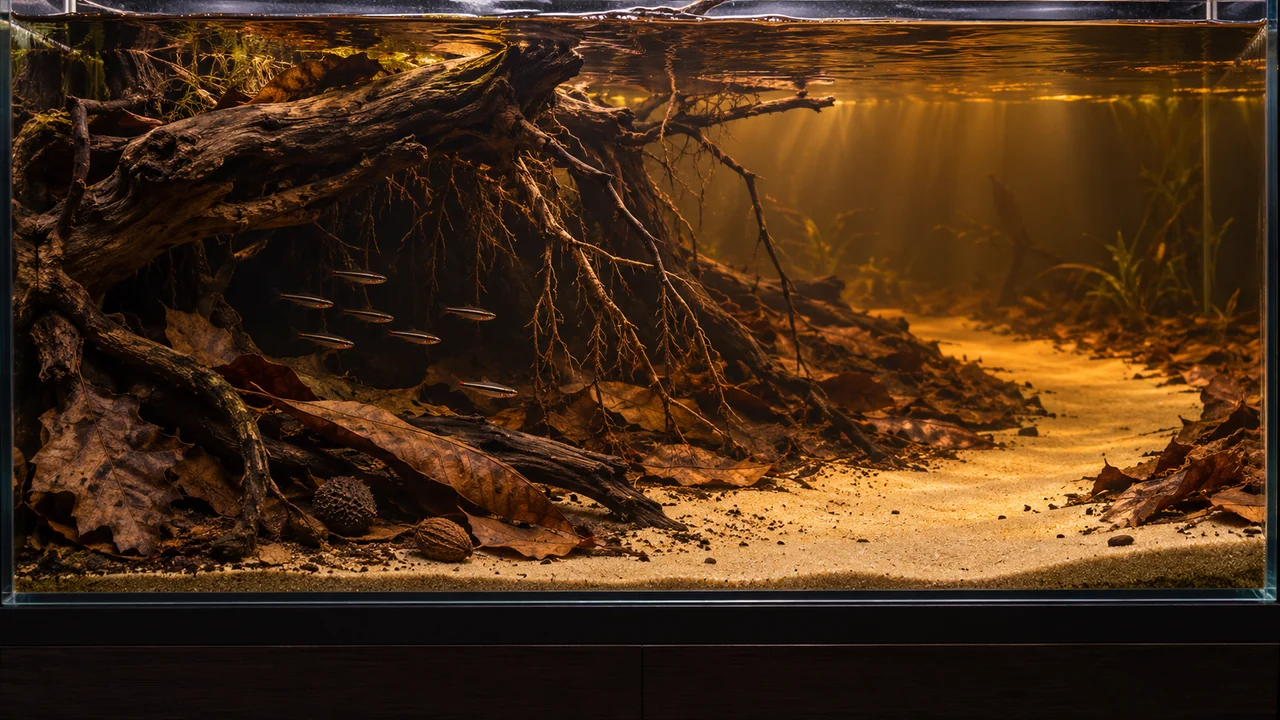
- Suggested shell
- 100 × 45 × 45 cm; a design starting point, not a universal stocking minimum.
- Visual structure
- One low bank, one bending channel and several small sheltered leaf catches.
- Equipment
- Mature biological filter, guarded intake, adjustable return, heater if needed and close-fitting cover.
- Water plan
- Choose the inhabitants first; amber colour is not a pH or hardness measurement.
A bend is a change of direction, not another root forest
The important shape is the water route. A low wooden bank occupies one end; an open strip of sand curves past its foot and narrows towards the opposite rear corner. Above it, the swimming space remains broad. This differs from a central branching display because the heaviest material sits low and to one side. The empty channel is the main line of the composition, rather than a gap waiting to be filled.
The inspiration comes from sheltered margins of forest tributaries, where roots, fallen material and differing flow create several small habitats close together. This is a habitat-inspired home aquarium, not a reconstruction of one named collecting locality. Choose a particular regional fish community if geographical accuracy matters, and check its requirements before deciding how dark or soft the water should become.
1. Choose the footprint and plan the equipment
A 100 × 45 × 45 cm shell gives useful front-to-back depth for the curve and access behind the bank. Sketch the open channel first, then reserve a hand-width route to the intake and enough clearance to lift a siphon beside the wood. Select a mature filter that can circulate the actual stocked volume without turning the sheltered side into a jet. Fit an intake guard appropriate to the smallest inhabitants.
Place the heater where moving water carries heat past it and where it can be removed without dismantling the bank. A close-fitting lid limits escape and evaporation; keep cables and pipe cut-outs closed appropriately. Check the filled weight against the aquarium stand and floor. Install the background and any concealed pipework now, while you can still see the route behind the hardscape.
2. Build the low bank before adding sand
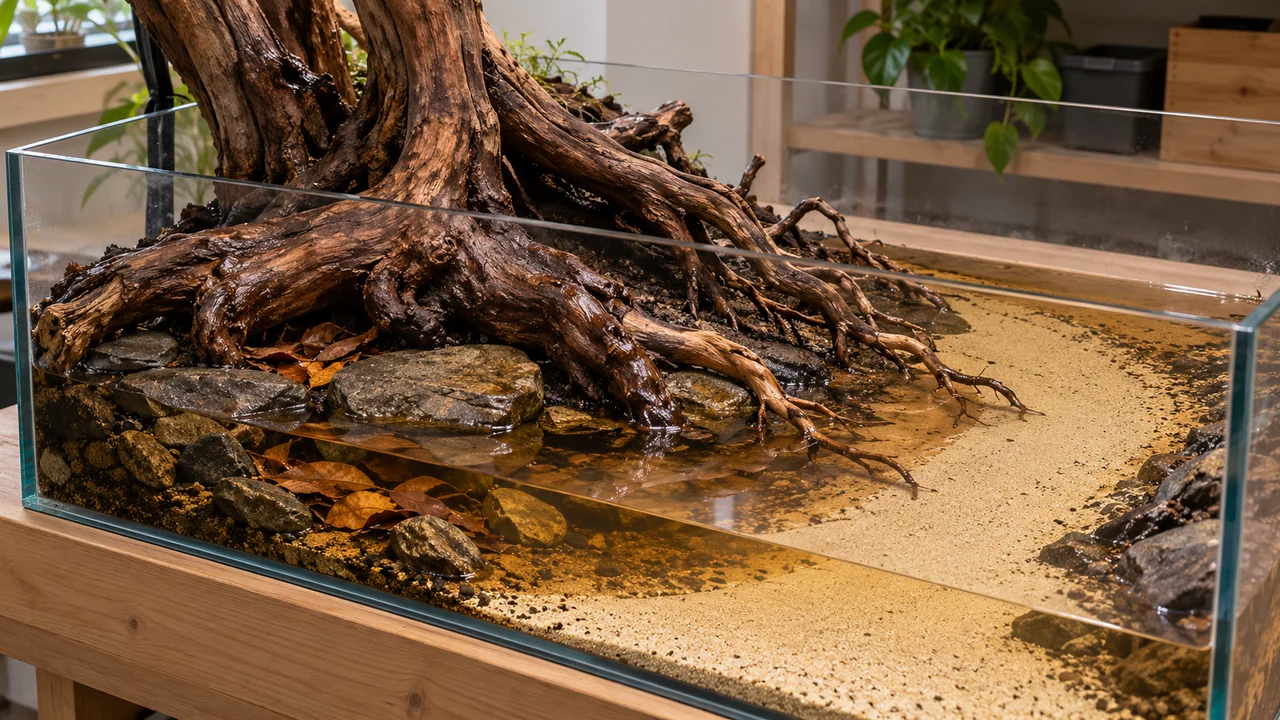
Choose one broad, aquarium-safe root base with a horizontal ledge, rather than several upright showpieces. Test it on the empty bottom using suitable load-spreading support where required by the tank maker. Add a second piece only if it continues the curve. Each contact should remain stable when pushed gently from more than one direction. Sand and loose leaves must not be the structural support.
Rinse inert fine sand and spread a shallow, accessible bed around the secured base. Keep the channel gently graded, not a steep dune that will slide against the glass. Turn thin root tips towards the bend without making a comb across the swimming lane. Check every enclosed gap for the intended animals: a shelter must have a safe entrance and an exit or a means of inspection.
For alternative structural detail around the low wooden bank, compare selected pieces from the Aquarium Botanical Starter Box – Pods, Cones, Musa Stem & Tropical Leaves with an individual Jequitiba Pod / Savu Pod. Inspect the actual openings, secure the chosen piece and leave the bending channel clear.
3. Prepare the leaves and establish the bend
Prepare botanicals separately following the botanical-preparation guide. Begin with a small amount of clean material: broad leaves can settle behind the bank foot, while narrow curled leaves make a loose transition to sand. A small open woody husk can add a different surface, provided its edges and openings suit the occupants. Do not fill all cavities simply because extra material is available.
During the first fill, direct water onto a plate or clean bag so the sand stays in place. Run the filter and observe where a few prepared leaf fragments settle. Use that information to adjust the return; do not chase a perfectly drawn curve with a powerful pump. The bank should provide a sheltered catch while water still exchanges through and around it.
For the bend’s sheltered catches, compare prepared Dried Arjuna Leaves (Kumbuk) – Natural Aquarium Leaf Litter with a few Casuarina Cones – Aquarium Botanicals as a smaller-textured accent. Keep both outside the main sand route, where settled material remains easy to inspect.
4. Plant the margin rather than closing the route
Keep the principal channel open. A small planting pocket at the rear can soften the bank edge, but a dense lawn would conceal the sand line that makes this project readable. If you use rooted plants, keep their nutrition in the planting pocket and follow the product instructions rather than spreading enriched substrate underneath the entire open channel. Leave room for mature roots and leaves.
For a habitat-style aquarium, robust epiphytes may be attached above the substrate with their growing rhizomes exposed as appropriate. They are not automatically South American plants; omit them or select verified regional species for a stricter geographical display. Choose lighting for the actual plants through the tinted water, not merely for a dramatic photograph. A shaded resting side and visible feeding area are both useful.
5. Set the water and introduce inhabitants deliberately
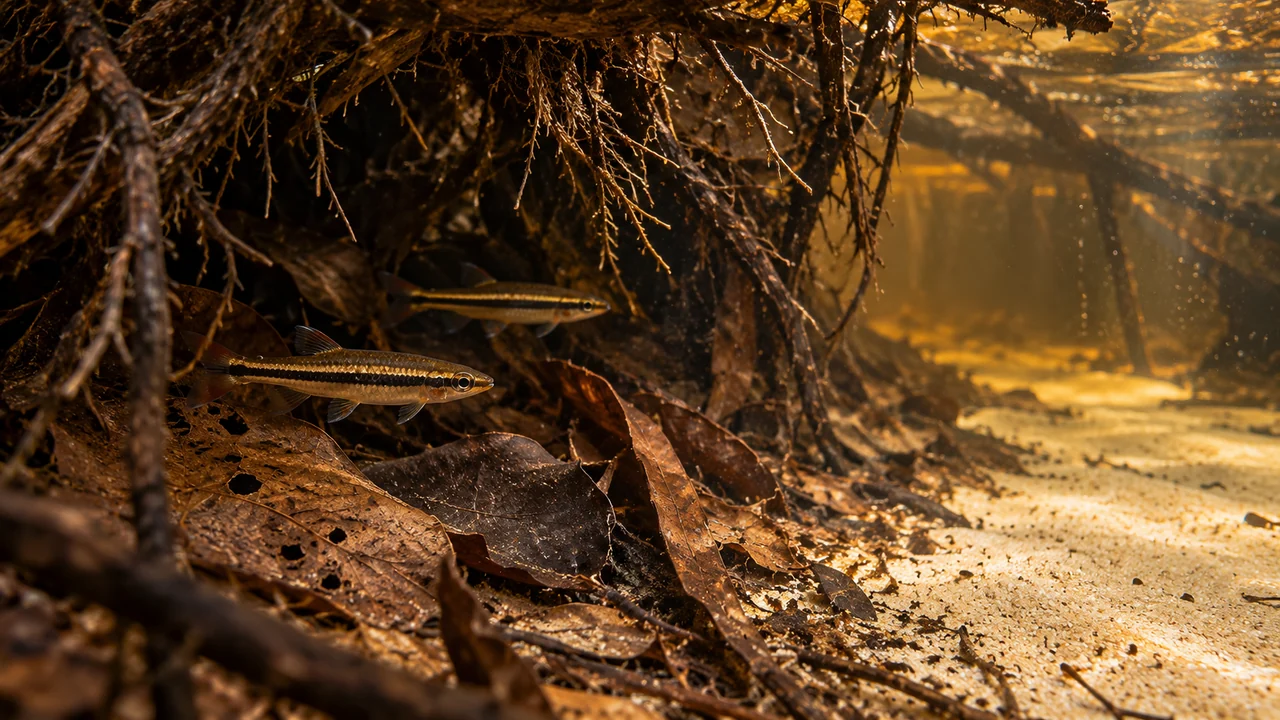
Dwarf pencilfish offer one possible direction for the sheltered upper water, subject to their own group, food and water requirements. Their BBA profile gives 22–28°C and soft to moderately soft acidic water as published guidance; a stable point within that range is more useful than copying an extreme field reading. The proposed footprint provides design space, not permission to add every compatible-looking Amazonian species.
Cycle the aquarium and verify ammonia and nitrite are controlled before stocking. Introduce a planned group rather than a decorative pair of shoaling fish. Check that the quiet individuals receive fine food outside the filter stream. Do not assume the leaf floor feeds them. Any shrimp, snails or bottom fish require a separate assessment of temperature, minerals, predation and feeding competition.
6. Make gentle circulation reach the hidden side
Aim the adjustable return along the open curve with enough surface movement for gas exchange. Look behind the bank after feeding: suspended debris should not continually accumulate around the intake or heater. If the front is clean but the rear smells foul or traps persistent sludge, the issue is access and circulation, not insufficient tannins. Move the outlet or reduce the obstruction before adding another pump.
Start with a moderate timed light period, for example six hours, and adjust to plant response and algae rather than extending it to brighten the amber view. Use a separate room light before and after the aquarium light if abrupt darkness alarms the fish. Check actual temperature at both ends during the first days, especially with a dense wooden bank shielding the heater.
7. Maintain the leaf pockets without flattening the design
At regular water changes, lift loose debris from the channel and inspect beneath the accessible bank lip. Remove softened accumulations in small sections, leaving sound material and mature surfaces elsewhere. Replace leaves gradually, not by emptying the entire aquarium floor at once. Keep the original open route visible so feeding observations and siphon access remain straightforward as the arrangement ages.
Inspect wood contacts after moving equipment or lifting a trapped leaf. Watch whether the fish use both sheltered and open water and whether all individuals feed. Cloudiness, distressed breathing or a marked change in behaviour calls for water testing, aeration and a check of recent additions. A deeper brown colour by itself is not evidence that either the filter or the habitat has improved.
When the bend stops working
If the channel looks like a straight stripe, turn the bank base rather than covering the problem with plants. If the bank dominates the whole tank, remove a secondary piece and restore open water above it. If leaves repeatedly escape into the foreground, move the collection pocket behind a lower root or soften the outlet. Do not bury leaves under a stone simply to make them stay in an unsuitable current.
If maintenance requires lifting the main structure each week, redesign its access while the aquarium is lightly stocked. The successful result is a legible low bank with a changing but manageable edge: enough cover for the chosen animals, enough open sand to observe them and enough water movement to keep the sheltered side connected to the rest of the tank.
Further reading and sources
Natural-history references inform the habitat discussion. Dimensions, construction sequence and maintenance access are BBA design proposals, not measurements from a documented wild site or a claim that the pictured aquarium has been stocked and tested. Choose livestock using the linked species guide.
- Amazon ecosystem functioning — Science Panel for the Amazon — Regional floodplain and forest-water context, not dimensions for this aquarium.
- Nannostomus marginatus — Seriously Fish — Species-specific maintenance and group-feeding context.