Fish · Black Phantom Tetra
Black Phantom Tetra — Megalamphodus megalopterus: Habitat and Care
Smoky bodies, contrasting shoulder markings and the male’s tall dark fins make the black phantom a rewarding group fish. Provide display space and broken sightlines without confusing it with the red phantom.
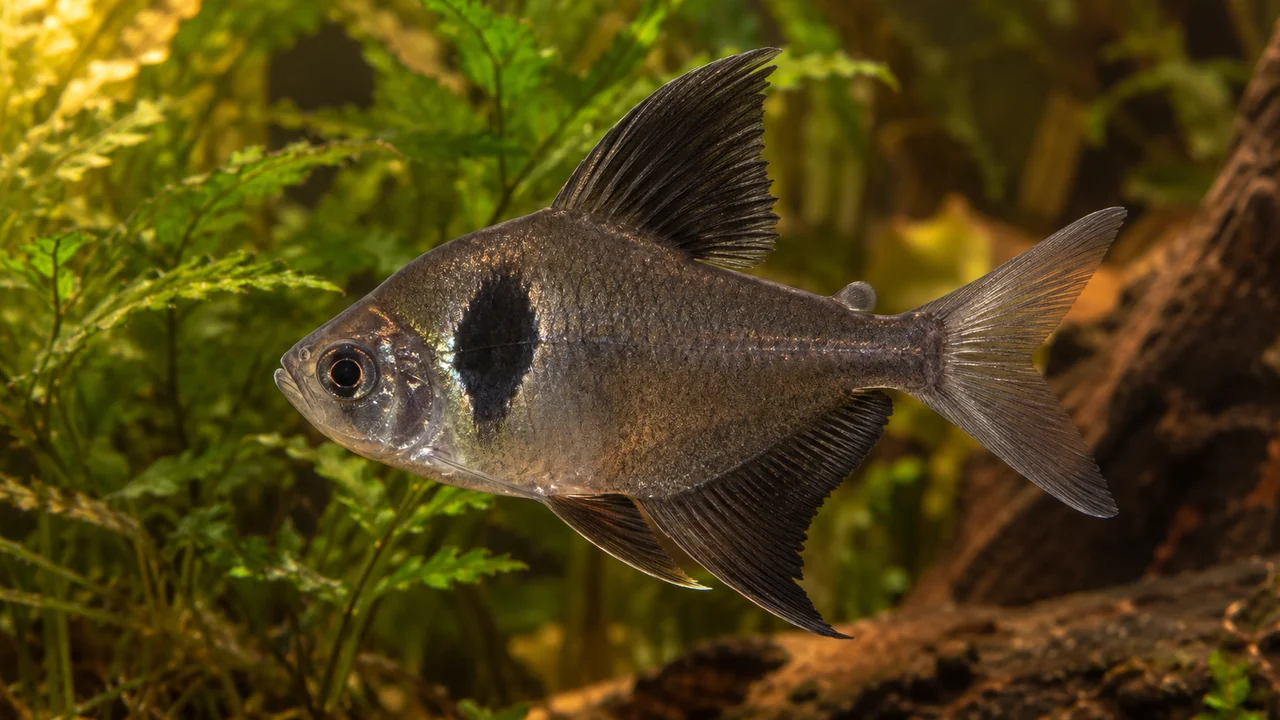
- Identity and size
- Megalamphodus megalopterus, formerly Hyphessobrycon megalopterus; around 3.6 cm standard length.
- Group and footprint
- Mixed group of at least 8–10; published starting base 80 × 30 cm, with room for separate display areas.
- Temperature
- Published 20–28°C; 23–26°C is a practical central choice, not a required daily fluctuation.
- Water
- Published pH 5.0–7.0; 1–12°dGH. Maintain a stable, established aquarium.
- Behaviour
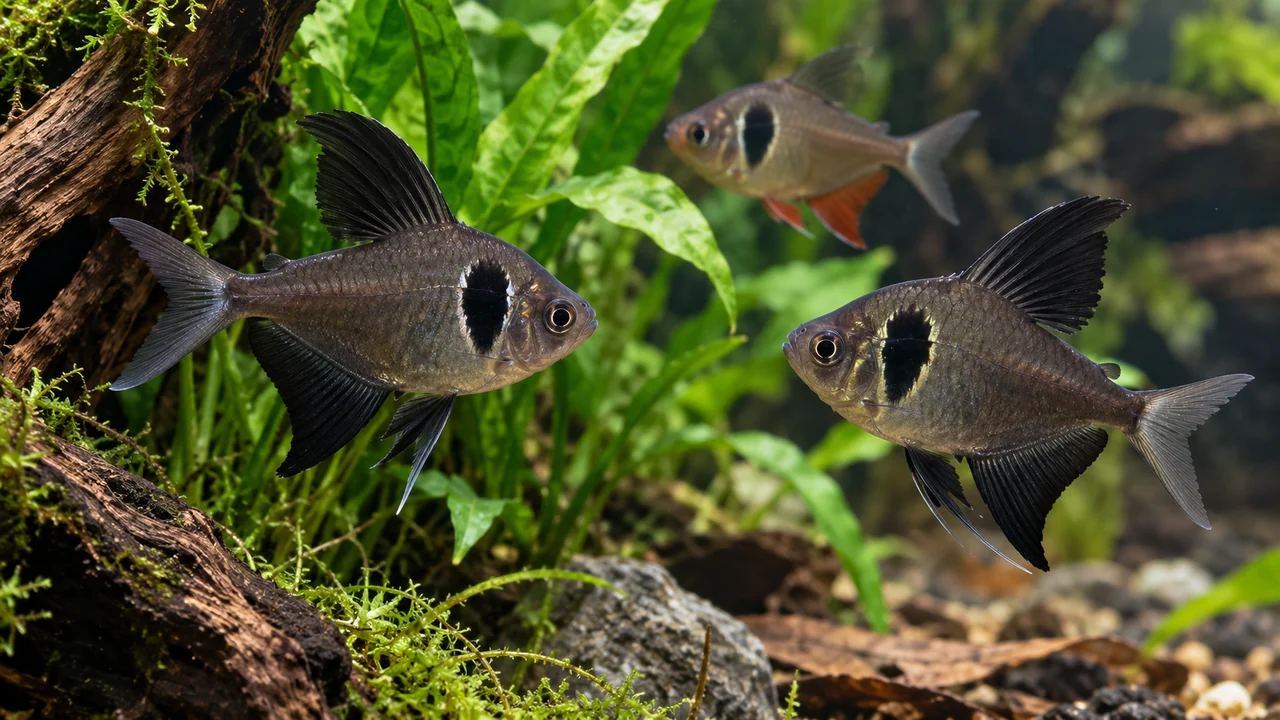
- Males display to rivals and females; provide retreats and check for persistent exclusion.
- Reproduction
- Egg scattering without parental care; eggs need protection from adults.
The black phantom’s identity
The dark shoulder patch, smoky body and male’s expanded black fins distinguish this fish from the slender striped tetras. Mature females can show reddish lower fins and a deeper body. Do not reject a female as the wrong species simply because she lacks a male’s dark sail; assess the whole pattern and the supplier’s identification.
Megalamphodus megalopterus is used following the restored genus in the 2024 phylogenetic classification. Hyphessobrycon megalopterus remains a useful older search name, not another fish requiring a second profile. Natural variation and selected long-finned strains can complicate a quick comparison. Unusually extended ornamental fins should also prompt a careful look at current strength, sharp furnishings and potential fin-nipping companions.
Where the habitat guidance comes from
Records place black phantoms in the upper Madeira and upper Paraguay systems of Bolivia and Brazil. Published accounts describe quiet margins and backwaters with vegetation or submerged roots. That does not make it interchangeable with every Orinoco red tetra, or require a heavily acidified aquarium for commercially bred stock.
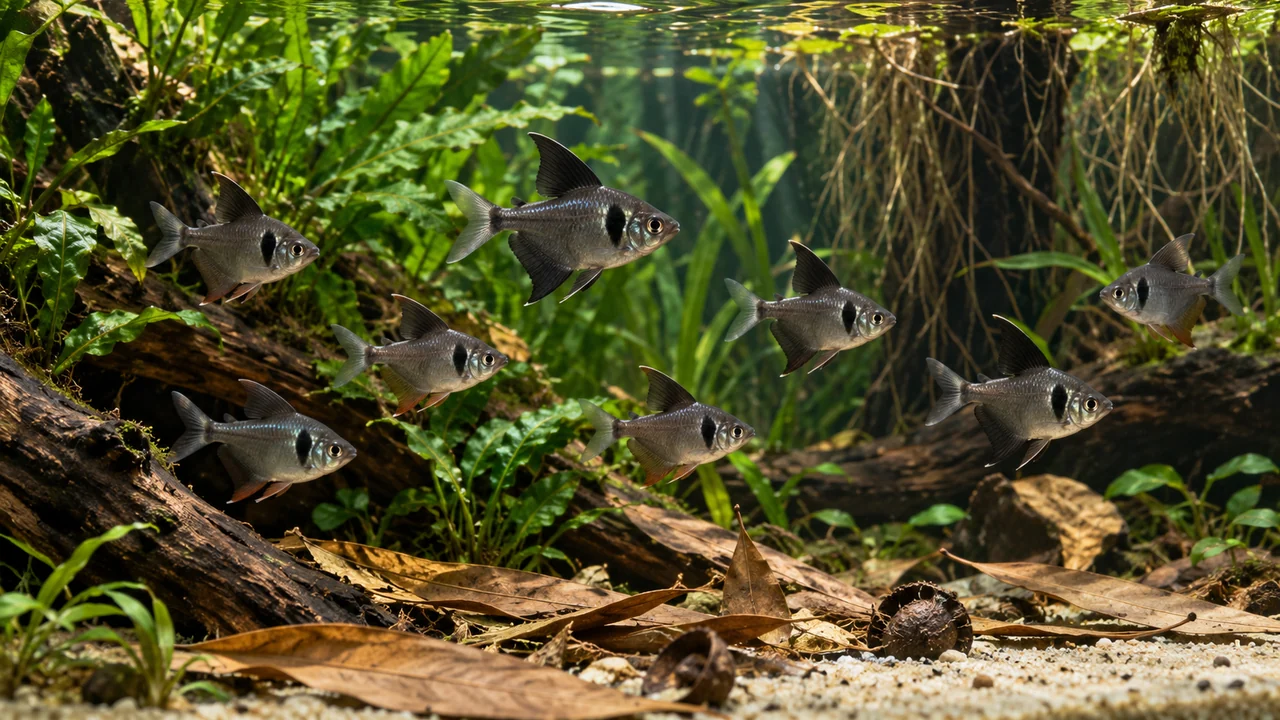
Translate that setting into sheltered edges, unobstructed midwater and gentle circulation. Dense planting at one end can be useful, but the group should not have to squeeze through a thicket to change direction. The illustrated arrangement is a layout example: its appearance is not a claim to reproduce a particular collection site or to document wild fish.
Social space for displays and retreat
Plan for at least 8–10 fish in an aquarium starting around an 80 × 30 cm base. A larger footprint makes it easier to provide several small display areas without eliminating the swimming route. Judge a community’s space from its combined adult occupants, not from the dimensions quoted for a single species group.
A male may turn side-on and spread his fins towards another male. Brief displays with both fish able to withdraw differ from repeated chasing of one individual into a corner. Break the view with plants or roots, keep several routes open and watch the quieter fish at feeding time. Buying a larger group is not a substitute for correcting a cramped layout or an unsuitable tankmate.
Stable water before darker water
The husbandry reference lists 20–28°C, pH 5.0–7.0 and 1–12°dGH. For routine adult keeping, a steady 23–26°C is a useful central choice. Choose an actual set point that fits the whole aquarium and the established stock; there is no advantage in running at the warmest listed value merely to intensify activity.
Use conditioned replacement water and a cycled filter, with surface movement that is not hidden beneath an unbroken mat of floating plants. Test ammonia and nitrite when introducing fish or if behaviour changes. Keep partial changes predictable and inspect low-flow areas behind roots. An aquarium can be visually clear while accumulating waste, or brown from tannins while otherwise well maintained; colour alone cannot resolve that question.
Building a practical planted arrangement
Use a main open lane with planting at the ends, rather than one enormous root in the centre. Smaller branches can form visual screens behind which a fish can pause without becoming invisible to its keeper. Leave room to pass a net or siphon so an attractive arrangement remains serviceable.
A shallow, scattered leaf layer gives texture to the floor and can support microbial growth, but it need not cover every surface. Inspect pods and wood for narrow traps and rough openings before installation. Make changes gradually so you can identify their effect. If a corner collects uneaten food, improve access or circulation rather than concealing it with another layer of leaves.
For the leaf-and-structure margin beside the shoal, compare Dried Mango Leaves – Natural Aquarium Leaf Litter with Aquarium Botanical Starter Box – Bakuli, Cones & Leaf Litter. Use selected material in small stages while keeping the swimming corridor and feeding area open. A mixed box provides material to choose from over time, rather than a quantity to add all at once.
Food, condition and competition
Give a suitable complete small-fish food alongside varied small frozen or live invertebrates. Spread modest portions across more than one position. The most assertive displaying male should not control every feeding point, and a fish that stays behind planting still needs a fair opportunity to eat.
Assess body condition over time instead of judging care by fin spread alone. A rounded female and a thin fish are different observations; look from above as well as from the side. Siphon persistent leftovers and adjust the next portion. Botanicals supply surfaces and environmental structure, not a measured complete diet, and they cannot make up for meals that never reach a subordinate individual.
For supplementary feeding variety, Premium Freeze-Dried Australian Blackworms is a freeze-dried worm blend to assess in a small portion matched to the actual mouth. Confirm that the fish takes and swallows it while retaining the accepted complete and live or frozen ration described above.
Choosing companions
Peaceful fish of similar scale can be suitable where their water and feeding requirements overlap. Avoid assuming that “tetra” means any combination is safe. Predatory adults, relentless fast feeders and habitual fin nippers can undermine an otherwise sound aquarium, especially with ornamental long-finned phantoms.
Check both directions of the relationship: can a companion swallow a phantom, and can the phantom consume very small offspring? Adult dwarf shrimp may coexist in a carefully planned display, but shrimplet survival cannot be guaranteed. Keep the middle water from becoming overcrowded even when bottom-dwelling species are also present. All occupants still contribute waste and need usable feeding space.
Breeding without confusing it with courtship
Flaring and chasing are not proof that eggs have survived. Black phantoms are egg scatterers without parental protection. If breeding is the aim, a separate mature setup with an egg-protection arrangement is more controllable than leaving eggs within a busy display.
Condition healthy adults with varied food and prepare tiny first foods before introducing a selected pair or group. Remove adults once spawning is established rather than expecting them to guard their offspring. Keep filtration gentle and fry-safe, and make small careful maintenance changes. Treat any specialist spawning-water recipe as a separate rearing decision, not a reason to abruptly alter the adults’ main aquarium.
Common problems and first checks
For torn fins, distinguish a one-off abrasion from repeated pursuit or progressive tissue damage. Inspect branches and gaps, observe social interactions when food is absent and check water quality. An extended fin can look impressive while still making an unsuitable current or tankmate combination more difficult.
For a persistently hidden fish, check feeding access and whether one location is being defended. For rapid breathing across the group, prioritise oxygenation, temperature and ammonia/nitrite checks. Do not assume every problem comes from insufficient tannins. Record the actual symptoms and recent changes, and seek appropriate fish-health help for illness rather than adding unmeasured treatments or dismantling the whole aquarium at once.
Further reading and sources
Species-specific husbandry references inform the care summary. Taxonomic and field sources answer different questions from aquarium recommendations; none establishes a treatment effect for a BBA product.
- Seriously Fish — Megalamphodus megalopterus — Species husbandry: adult size, group, footprint, water conditions and reproduction; distinguish the stated range from a daily target.
- Melo et al. (2024) — phylogenomic classification — Primary taxonomic revision supporting Megalamphodus; not an aquarium-care experiment.
- FishBase — Megalamphodus megalopterus — Current-name institutional occurrence entry; not a stocking prescription.