Fish · Red Phantom Tetra
Red Phantom Tetra — Megalamphodus sweglesi: Habitat and Care
A small red tetra with a dark shoulder patch and expressive fin displays. Give it its own cooler-centred care plan and planted retreats instead of borrowing the black phantom’s settings.
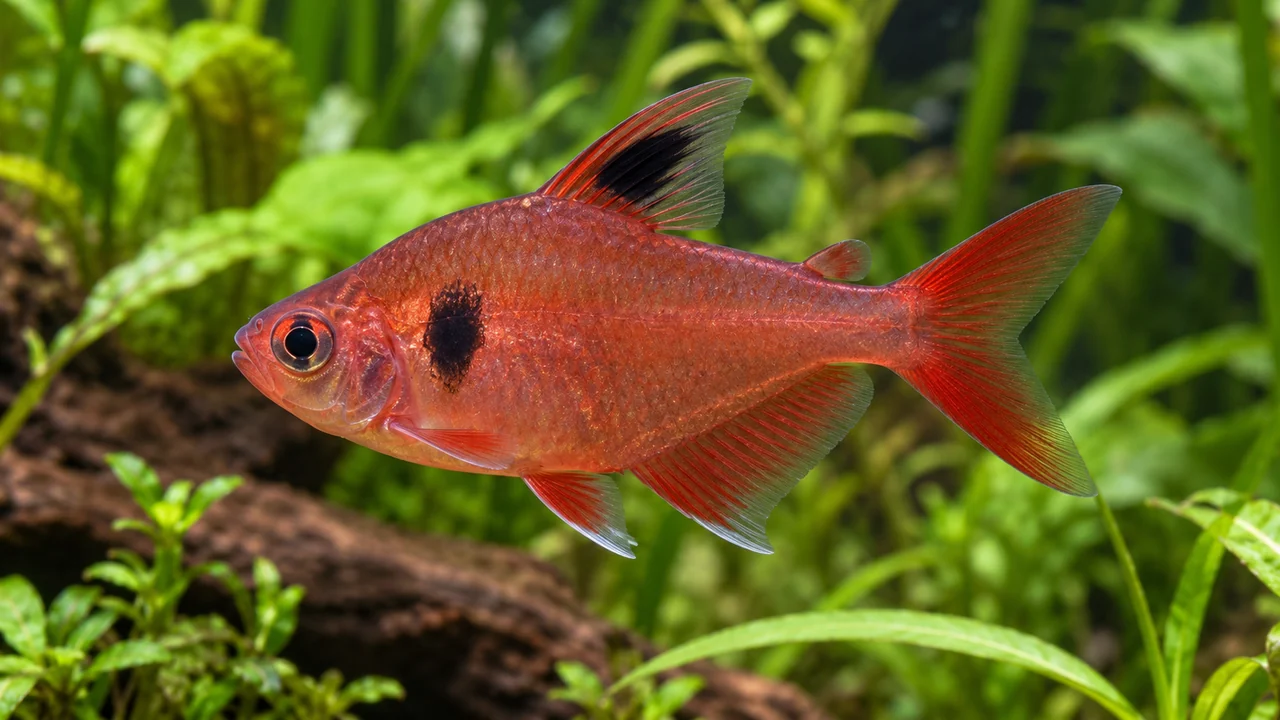
- Identity and size
- Megalamphodus sweglesi, formerly Hyphessobrycon sweglesi; about 3.5 cm standard length, roughly 4 cm overall.
- Group and footprint
- Mixed group of 8–10 or more; start with an 80 × 30 cm base and allow additional community space.
- Temperature
- A stable 22–24°C is a supported routine choice; wider published ranges do not require permanently hot keeping.
- Water
- Soft, mildly acidic water is a useful aim: around pH 6–7 where practical; published hardness guidance 1–12°dGH.
- Food
- Fine complete foods and varied small invertebrates, with feeding access for quieter fish.
- Breeding
- Freshwater egg scatterer without parental care; very small fry need planned first foods.
Identify the fish behind the colour
Look for the compressed red body, dark shoulder mark and fin pattern together. A red tetra with a black patch is not automatically this species: serpae and other rosy tetras can be confused in mixed shop tanks. Ask for the scientific identification and compare body shape, fin markings and origin where available, rather than choosing by colour intensity alone.
Megalamphodus sweglesi is used following the restored genus in the 2024 classification. Hyphessobrycon sweglesi remains an older search name for this same profile. Red intensity varies with condition, sex and lighting; unusually saturated sales photography is not a standard every healthy fish must match. The black phantom is a separate species, not a dark colour form of this one.
Orinoco origins and the aquarium lesson
The species is associated with the upper and middle Orinoco drainage in Colombia and Venezuela. That differs from the black phantom’s range. Habitat accounts include tributaries and floodplain waters, but a geographical range cannot be reduced to a single temperature or mandatory water colour.
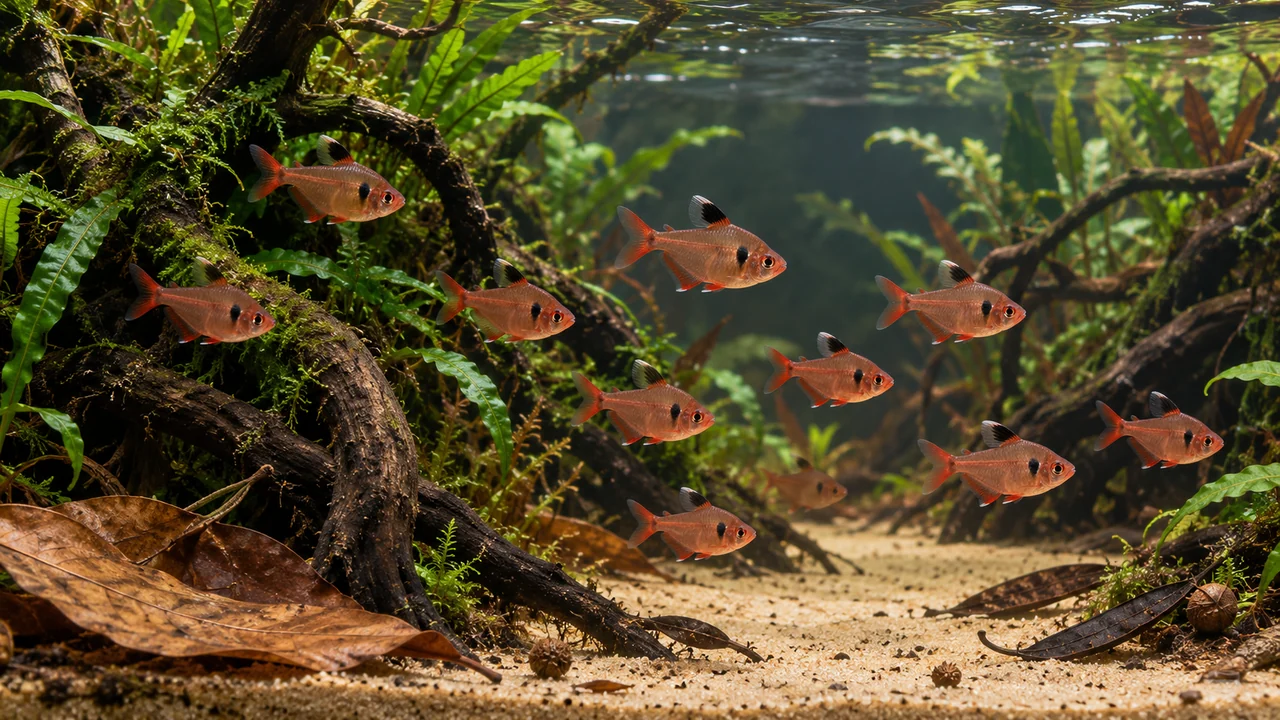
A home arrangement can borrow shaded edges, roots and open water without claiming to recreate a named collection site. Planting at the margins and a manageable floor make observation straightforward. Keep enough open space to see the shoal feeding and assess each fish. A solid bed of decomposing leaves is not necessary to make the design convincing, and it can make accumulated food harder to find.
Group size and display space
Use an 80 × 30 cm base as the published starting footprint, with more room for companions. Aim for 8–10 or more rather than a solitary fish or a pair. A long aquarium offers more useful passing and display room than a tall narrow container of similar capacity.
Males may spread their fins towards rivals and females. Provide several retreat routes so a fish can withdraw without losing access to food. Brief displays differ from constant pursuit of the same individual. Check for exclusion at meals and damaged fins; do not assume that planting alone will resolve a poor social arrangement. A practical separation option is more useful than repeatedly adding decoration to an already crowded aquarium.
Choose a temperature for this species
A stable 22–24°C is a useful routine choice, supported by Tetra’s husbandry account. Seriously Fish publishes a broader 20–28°C range. Do not convert the upper endpoint into the default or heat the aquarium automatically to suit warmer-water companions. Select the community around the temperature actually maintained.
Chemistry recommendations also differ between sources. Here the practical preference is soft, mildly acidic water, around pH 6–7 where feasible, rather than the very alkaline end of a commercial table. Measure GH and KH separately and know the replacement-water source. Avoid abrupt mineral or pH changes. These are care choices within published guidance, not a claim that every fish outside a narrow chosen target is immediately in danger.
Filtration and a serviceable layout
Use established biological filtration, a gentle distributed return and visible surface movement. Keep floating plants from sealing the entire top. Check ammonia and nitrite after introductions or when behaviour changes, and maintain partial water changes even when the aquarium still looks clear.
Rootwork and plants can provide soft visual boundaries beside a central swimming lane. Leave a clear feeding area and room for a siphon. Add modest amounts of prepared leaves, keeping gaps where waste can be removed. If a pod traps food that cannot be reached, reposition it. The useful botanical arrangement is one that remains easy to inspect and clean, rather than one that looks dense from a single camera angle.
For the leaf-and-structure margin beside the shoal, compare Dried Oak Leaves – Natural Aquarium Leaf Litter with BBA Leaf Litter & Substrate Variety Mix – 1 L Seasonal Botanical Blend. Use selected material in small stages while keeping the swimming corridor and feeding area open. A mixed box provides material to choose from over time, rather than a quantity to add all at once.
Small food and fair access
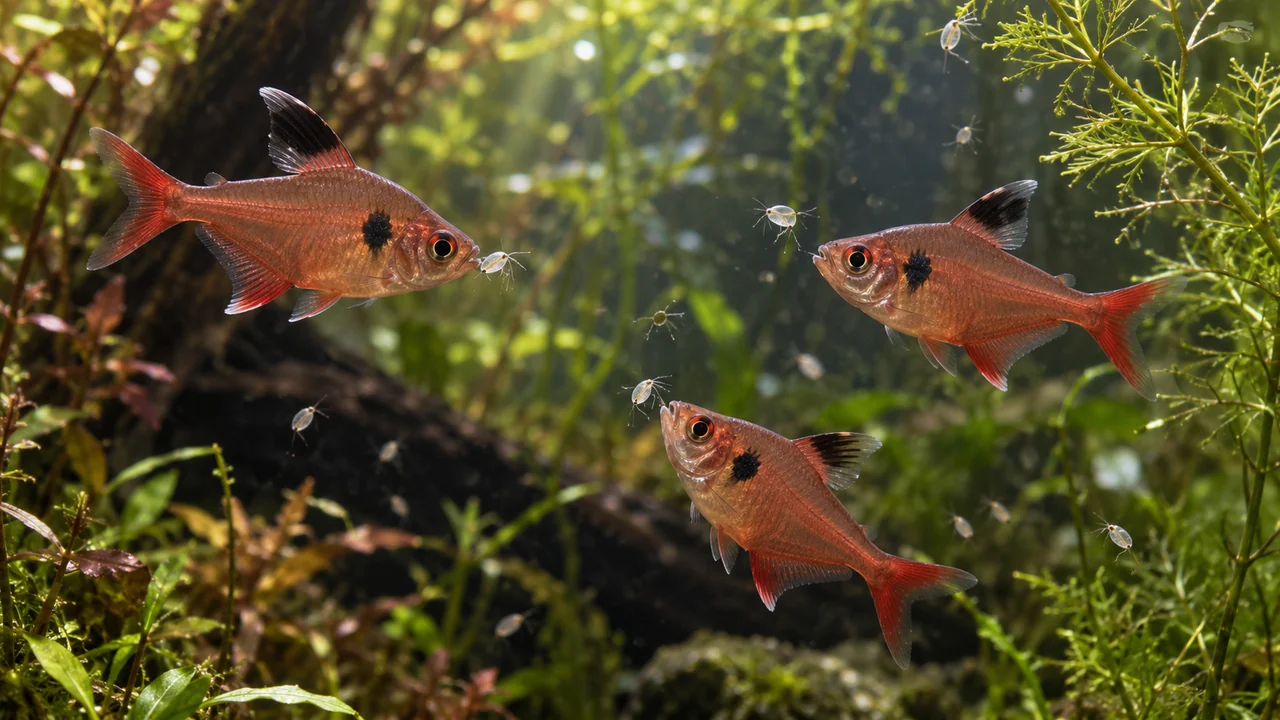
Offer fine complete flakes or granules that fit the mouth, with suitably sized live or frozen foods for variety. Small water fleas and Artemia are options; large food sold for tropical fish is not automatically a suitable mouthful. Check actual swallowing instead of simply seeing fish approach the feeding point.
Spread modest portions across several places when assertive fish dominate the first drop. A fish that repeatedly spits food may need smaller particles; a fish that never emerges may be intimidated or unwell. Adding more food does not reliably solve either problem. Judge colour alongside body condition and activity rather than pursuing redness through heavier feeding or unsupported botanical promises.
For supplementary invertebrate-food variety, Microalgae Freeze Dried Tubifex Worm Cubes offers a freeze-dried cube format that can be presented at the surface or against the glass. Offer only an appropriately small wetted portion the fish can swallow; this is a prepared food, not live prey or a fry starter.
Companions and overlapping needs
Choose small peaceful companions whose routine temperature and water needs overlap. An aquarium maintained at 22–24°C for red phantoms is not automatically suitable for every South American species. Consider adult mouth size and feeding speed alongside the label “peaceful”.
Predators, persistent fin nippers and relentless fast feeders are poor partners. Shrimplets and fish eggs remain potential food; calm adult behaviour is not a guarantee that another species can breed safely. Several midwater groups also share the same physical corridor, even if a shop describes them as different layers. Increase usable space or reduce the combination instead of relying on a nominal litre count to settle every compatibility question.
Breeding and tiny fry
Red phantoms scatter eggs and provide no parental care. A separate mature setup gives better control over egg predation and rearing than a busy community. The older Aquarium Glaser account highlights very small fry and slow early development: courtship should not be mistaken for easy juvenile production.
Prepare tiny first foods before spawning, protect eggs from adults and use gentle fry-safe filtration. Make careful small water changes instead of aggressively cleaning around newly hatched fish. Specialist spawning-water choices are separate from daily adult maintenance. A surviving fry in a planted display is welcome, but does not prove that a whole brood can be raised without deliberate feeding and a suitable rearing plan.
First checks when something changes
For faded colour, review transport, lighting, companions and water readings. Check the actual temperature with a thermometer, especially in summer or after changing a heater for another species. Faster breathing combined with reduced appetite warrants prompt attention to oxygenation and water quality.
For one thin fish, observe individual feeding and look for exclusion or illness. For a hidden group, check exposed space and disturbance before changing chemistry. Record recent additions and symptoms. Do not add leaves, medication and a pH product simultaneously: that makes the cause harder to understand. Seek suitable fish-health advice for persistent illness rather than treating water colour or a red body as diagnostic evidence.
Further reading and sources
Species-specific husbandry references inform the care summary. Taxonomic and field sources answer different questions from aquarium recommendations; none establishes a treatment effect for a BBA product.
- Seriously Fish — Megalamphodus sweglesi — Species husbandry: adult size, group, footprint, water conditions and reproduction; distinguish the stated range from a daily target.
- Melo et al. (2024) — phylogenomic classification — Primary taxonomic revision supporting Megalamphodus; not an aquarium-care experiment.
- Tetra — Red Phantom husbandry — Supports 22–24°C routine keeping and social displays. Broader chemistry and geographical wording are not adopted uncritically.
- Aquarium Glaser — Red Phantom observations — Older first-hand importer/breeder account of identification and demanding small fry; not a current stock claim.