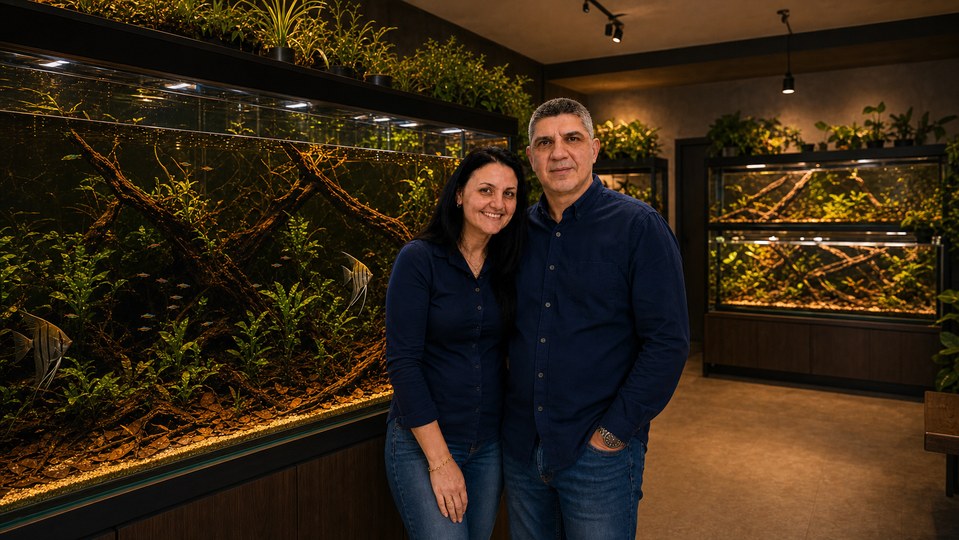
BBA Case Study 01
Inside a Mature 1,200-Litre Botanical Aquarium
Two years of warm-water operation, large-scale filtration and a continuously changing botanical environment.
Built gradually from an empty large-volume system into the mature aquarium shown here.
The beginning
This started as an empty aquarium.
I did not begin with a finished recipe. I began with a large empty volume, a filtration plan, deep quartz sand and a set of unusually large Cholla pieces.
I added plants, fish and botanicals progressively to a system designed to mature rather than remain visually fixed. Around two years later, it has become a warm, established botanical environment in which leaves, pods, wood, plants and livestock continually interact with the filtration, aeration and maintenance behind them.
The finished look is the result of the system behind it.
Case study at a glance
The working system
These are the practical conditions and equipment behind the aquarium as I operate it today.
- Volume
- ~1,200 litres
- System age
- ~2 years
- Temperature
- 28–30°C
- pH
- ~5.5–6.0
- KH
- ~3–5 dKH, approximate
- Nitrite
- 0 mg/L
- Nitrate
- ~10–15 mg/L
- Ammonia
- 0 mg/L
- Substrate
- ~170–200+ kg quartz sand
- Main filtration
- 2 × Aquael Hypermax 4500
- Biological media
- ~20–24 kg Biohome Mini total, estimated
- Mechanical prefiltration
- 4 external sponge prefilters
- Aeration
- 3 high-output air pumps
- Heating
- 2 × 500 W + 1 × 300 W
- Lighting
- 5 integrated full-spectrum LED units
- Water changes
- ~40% every 3–5 weeks
- Main livestock
- 7 × Pterophyllum altum
- Supporting community
- Mixed tetras, Corydoras and Ancistrus
The system, not the recipe
The individual botanicals change. The underlying system does not.
I never built this aquarium around a fixed botanical recipe. The leaves and pods visible today are not the same selection that was present months ago.
Natural material enters the aquarium, becomes waterlogged, softens, fragments and is gradually replaced or supplemented.
There is no official “1,200-litre BBA botanical dose” here.
The more useful question is how I have enabled the aquarium to carry a constantly changing botanical layer as part of normal long-term operation.
For readers selecting materials for their own larger layout, compare the BBA Grand Botanical Habitat Box – 705-Piece XXL Collection for 800–1600 L Aquariums with the Large Botanical Box PLUS – 150L. These are current shop supplies to select from gradually, not a record of the products used in this aquarium or a recommended dose for 1,200 litres.
The visual build story
From empty glass to a mature botanical system
I built the result progressively. Each stage gave the next one a physical and biological foundation.
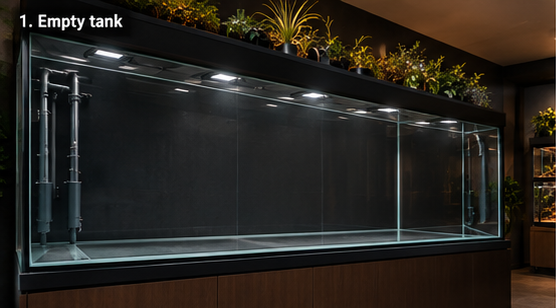
Stage 1
The Empty System
My starting point was not decoration. It was capacity: enough water volume, filtration, heating, oxygenation and physical access to support the system I intended to build.
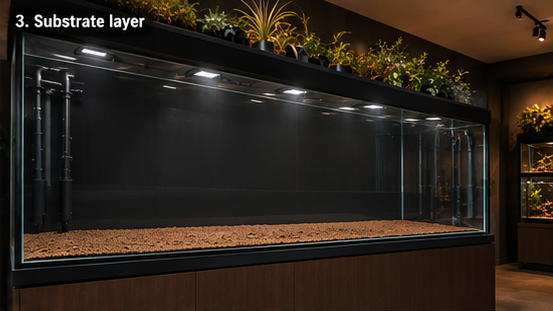
Stage 2
Quartz Substrate
I used approximately 170–200+ kg of quartz sand to establish the broad bottom area and the physical base for the future planting, Cholla structure and botanical layer.
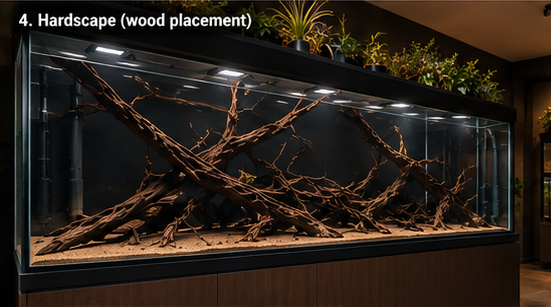
Stage 3
Cholla Structure
I used eight unusually large Cholla pieces to create the first major visual structure, breaking up the huge open volume before plants and smaller natural materials were added.
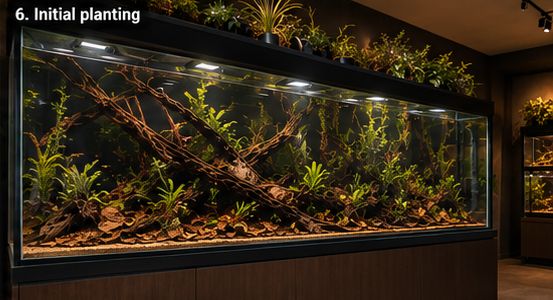
Stage 4
Initial Planting
I began using plants to connect the large wood structure with the substrate and open water, giving the hardscape something to grow into rather than simply sit beside.
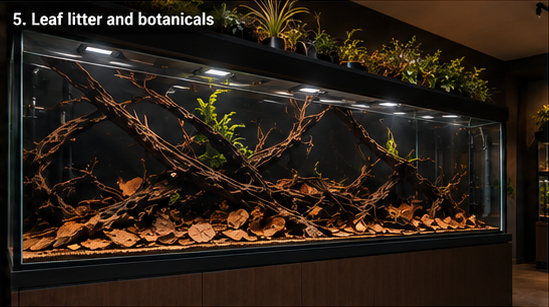
Stage 5
The First Botanical Layer
I added leaves, pods and other natural materials to change the clean sand-and-wood layout into a more complex litter-based environment.
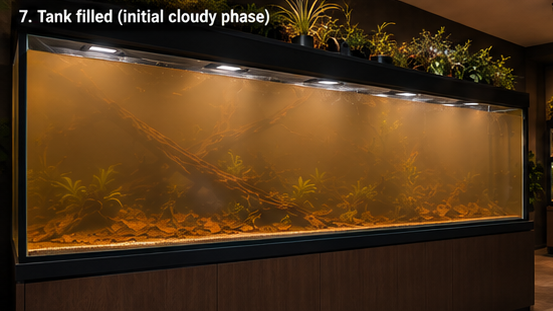
Stage 6
First Fill
Once I filled it, the system began behaving like an aquarium rather than a dry composition. Wood, plants, substrate and natural materials started settling into their aquatic roles.
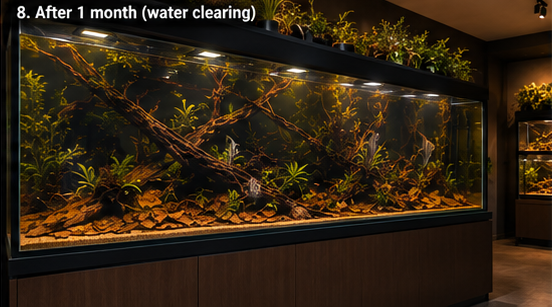
Stage 7
The System Begins to Settle
Over time, the filters matured, surfaces aged, botanicals waterlogged and softened, plants established and the aquarium began to lose the visual neatness of a newly built aquascape.
Stage 8
Mature Botanical Aquarium
After around two years, I no longer see a collection of newly placed parts. Wood, plants, litter, livestock and equipment now operate as one mature system.
Hardscape at aquarium scale
Hardscape built for the scale of the aquarium
I specially sourced eight custom Cholla cactus pieces from the United States. Each is approximately 90 cm long and 6–7 cm in diameter.
In many aquariums, Cholla is a relatively small tube or decorative piece. At this scale it becomes major hardscape: intersecting structure, broken sight lines, shaded areas, physical complexity and extensive surfaces integrated into the planting.
Quartz sand
A broad sand bed that is allowed to change
I used approximately 170–200+ kg of quartz sand, but I do not maintain it as a permanently immaculate aquascaping surface.
I allow leaves, fragments and smaller botanical material to settle across parts of the floor while other areas remain more open. The substrate itself changes visually as the botanical layer turns over.
The botanical layer
A rotating botanical layer
The exact composition visible at any one time is only a snapshot.
I work with broad material categories rather than a fixed recipe: dried leaves, mixed leaf litter, pods, woody pods, fruit husks, structural dried botanicals, Cholla wood and other suitable dried plant materials.
Older materials break down and I add new material for renewal and variation. The botanical layer is part of my ongoing aquarium management, not something I added once during setup.
- DryNatural material enters the aquarium.
- WaterloggedIts weight, position and surface condition begin changing.
- Surface colonisationAquatic surface communities develop.
- SofteningRigid plant material begins losing structure.
- FragmentationMaterial becomes increasingly incorporated into the aquarium floor and litter.
- RenewalI supplement older material with new leaves and pods.
The life-support system
The system behind the view
A large warm aquarium carrying fish, plants and continually decomposing botanical material needs more than attractive hardscape. The visible aquarium depends on the substantial life-support system I run behind it.
- Mechanical prefiltration
- High biological capacity
- Strong aeration
- Distributed heating
- Controlled water replacement
- Continuous botanical turnover
Filtration architecture
Two parallel filtration paths
I split the mechanical and biological work across two matching canister paths.
- Aquarium
- 2 × sponge prefilters
- Aquael Hypermax 4500
- Biohome Mini
- Aquarium
- 2 × sponge prefilters
- Aquael Hypermax 4500
- Biohome Mini
Four prefilters
Mechanical filtration before the main canisters
I use four sponge prefilters, two before each Hypermax. Each is approximately 8 litres, giving around 32 litres of combined prefilter volume.
They are my first line of defence against the physical debris created by fish, food, plants and decomposing botanical material. Much of the mechanical cleaning happens before debris reaches the large biological-media mass inside the Hypermax filters.
Mechanical dirt is dealt with before the main filters are asked to do the biological work.
Biological capacity
Using the main filter volume for biology
I removed the original sponge-heavy internal arrangement so that a much larger proportion of the Hypermax basket volume could be dedicated to Biohome Mini.
Each Hypermax carries an estimated 10–12 kg, or approximately 20–24 kg in total. The installed media mass is my estimate rather than a recorded installation weight.
Oxygenation
Oxygenation is part of my life-support design
3 high-output air pumps~3,500 L/h nominal each~10,500 L/h nominal combinedNominal manufacturer-rated output.
I operate the aquarium at 28–30°C. Warmer water holds less dissolved oxygen than cooler water, while the system also supports fish, plants, large biological filters and decomposing natural material. I therefore treat strong aeration as life support, not decoration.
Heating
1,300 W of installed heating capacity
500 W + 500 W + 300 WAll three heaters operate inside the aquarium water.I use multiple heaters to distribute the installed heating requirement across the system rather than depending on a single heating element. My operating temperature is 28–30°C.
Lighting
Five integrated LED units
5 full-spectrum LED unitsMounted in the aquarium's shared lighting body.I use the shared lighting body to spread light across the length of the aquarium and the established planting.
Livestock
A large South American-style community
The main livestock is seven Pterophyllum altum. I also keep a broader mixed community of tetras, Corydoras and Ancistrus, including approximately 6–7 tetra species, 6–7 Corydoras species and several Ancistrus species.
Planting
Plants growing into the structure
Mixed established planting now grows around and through the large Cholla hardscape. Rather than hiding the hardscape completely, the planting has become part of the same visual structure over time.
Water management
The routine that supports this particular system
I change approximately 40% of the water every 3–5 weeks. My replacement water is approximately 20% of the tank volume from tap water and 20% from RO water.
This is the routine of this established aquarium, not a universal schedule for other systems.
Recorded water conditions
- Temperature
- 28–30°C
- pH
- ~5.5–6.0
- KH
- ~3–5 dKH, approximate
- Nitrite
- 0 mg/L
- Ammonia
- 0 mg/L
- Nitrate
- ~10–15 mg/L
These are the routine conditions I have recorded while the aquarium has been operating as a mature botanical system.
What has changed over two years
The aquarium no longer looks newly assembled. It looks lived in.
Two years of operation have changed almost every visible natural surface. The Cholla has aged into the planting. Leaves and pods have repeatedly entered and disappeared into the botanical cycle. The sand bed now contains material at different stages of breakdown. Plants have grown into the hardscape.
Maturity is visible because I have allowed the system to change.
What I have actually observed
Two years of documented system behaviour
I have operated this aquarium for around two years with continuously changing botanical material, decomposition within the system, 28–30°C water, substantial community livestock, mature planting, large biological-media capacity and strong aeration.
During established operation, my routine measurements have shown no measurable nitrite or ammonia, with nitrate commonly around 10–15 mg/L.
What we can learn from one working system
Observation gives us context without turning one aquarium into a universal rule.
This aquarium shows that one large, warm, heavily filtered system has operated for around two years while I continually incorporated botanical material. That is useful real-world information.
What it cannot do is isolate one variable. I also use RO water, substantial biological filtration, strong aeration, mature planting, a large water volume and my own feeding, stocking and maintenance routine. There is no otherwise identical control aquarium without botanicals.
This case does not prove that botanicals:
- lowered the pH;
- reduced nitrate;
- prevented disease;
- increased immunity;
- caused a particular behaviour;
- increased lifespan.
I am documenting what happened inside one complete working system. I am not reducing that system to one magic ingredient.
The practical lesson
The lesson is not a botanical dosage
The strongest lesson I take from this aquarium is not a number of leaves or pods per 100 litres. It is what had to exist around the botanical layer for the whole aquarium to mature.
- Mechanical prefiltration
- High biological capacity
- Strong oxygenation
- Warm, established environment
- Controlled water replacement
- Continuous botanical turnover
Botanicals are one part of my aquarium ecology. They sit inside a wider system of filtration, oxygenation, water management, plants, livestock and routine care.
The dream is the finished aquarium.
The work is the system that allows it to exist.
Reader takeaway
What to take from this case study
- Build the life-support system before chasing the finished look.
- Design filtration around the load you intend the aquarium to carry, not only around its water volume.
- Treat oxygenation as essential in warm, organically rich water.
- Let natural materials change rather than expecting a permanently fresh aquascape.
- Maintain the system, not a frozen photograph.
- Use botanical material as one part of the ecology, not as a substitute for responsible aquarium management.
Continue with BBA
Explore the thinking behind botanical aquariums.
Read the practical foundations, then choose the route that fits your own aquarium.
Read the connected guidance
From one working system to your own decisions
Use these guides to examine the principles without copying this aquarium's stocking or material quantities.